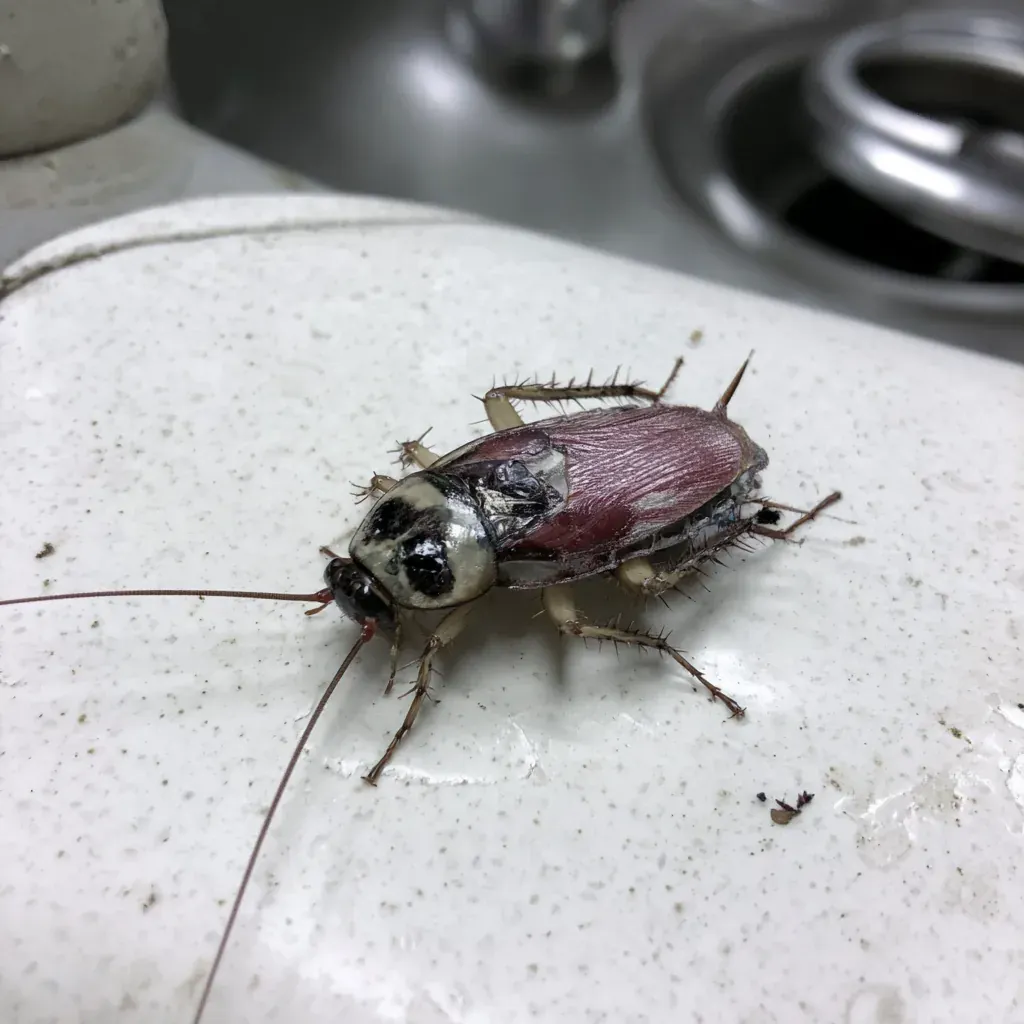
Identification
Why Roaches Come Inside After Heavy Rain in Fayetteville, NC
Big roaches after a summer storm are a water story rather than a kitchen story. Here is where they come from and…
Read article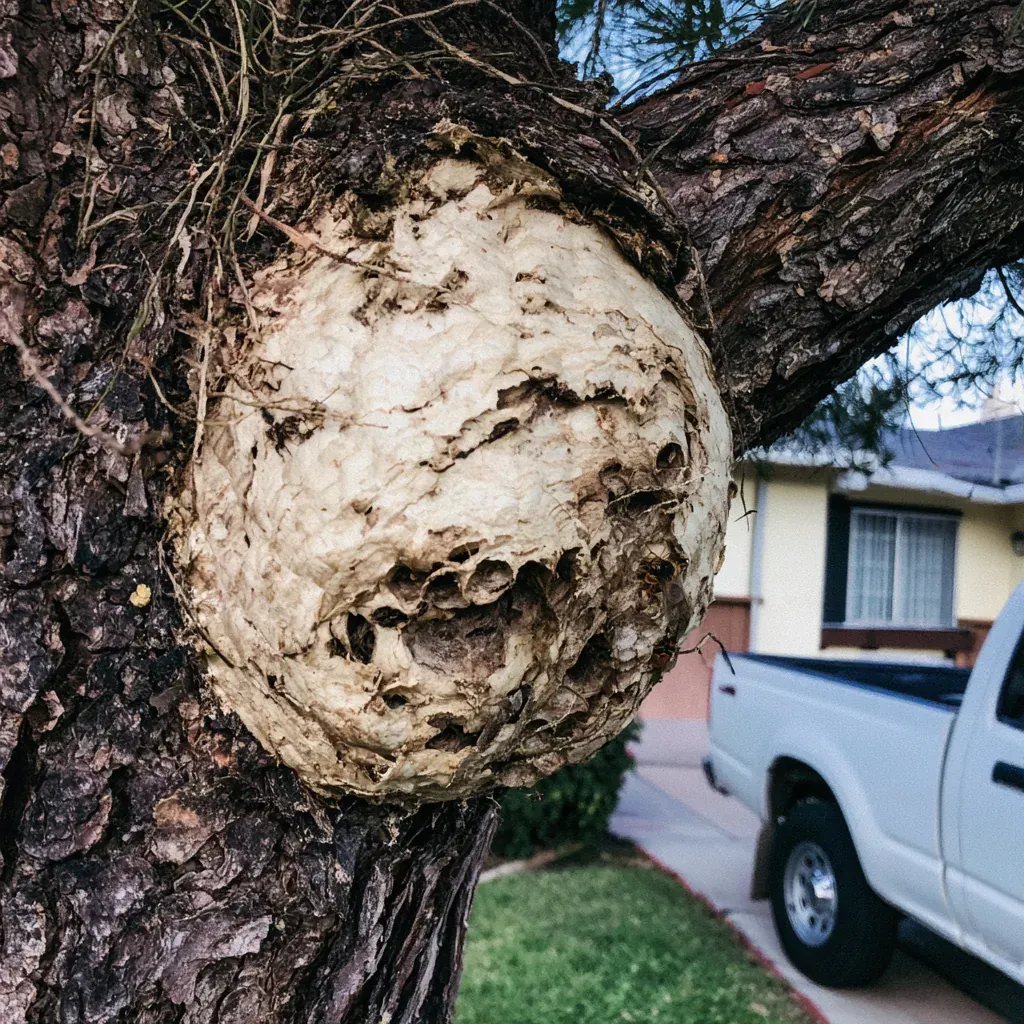
Mud daubers, paper wasps and yellowjackets are three separate calls, and only one of them needs somebody in a suit.
Three different insects get called wasps around Cumberland County, and they do not want the same answer. Mud daubers build the tidy clay tubes you find on porch ceilings and under eaves. They are solitary, they hardly ever sting, and once the tube is empty knocking it off and washing the mark is the entire job. Paper wasps build the small open comb with the cells showing, tucked under a rail, a shutter, a grill lid or inside a mailbox. A few of those well away from the door can be left alone all summer, and they will take caterpillars off your tomatoes while they are there.
Yellowjackets change the answer completely. Their nest is hidden, holds a lot of workers by late summer, and sits in a wall void, a soffit, a hole in the ground or the sandy bank of a ditch. They defend it as a group and sting repeatedly. A nest in a wall void or in a bank is the one not to approach with a hardware store can: the opening you can see is not the nest, a good share of the colony is out foraging and comes back to whoever is standing there, and material sprayed into a void from outside can push them through the drywall into the room.
Fayetteville homeowners see this most along fence lines and pasture edges, where a ground nest near Hope Mills or a bank burrow tucked close to Cross Creek gets discovered by a mower blade before it gets seen by an eye. A rotted stump in a Haymount yard or a woodpile stacked against a Hope Mills Lake fence can look empty and still hold thousands. The licensed pros we connect you with know which of those openings to leave alone and which one is actually worth a call.
Crawl spaces tell a different story than yard debris, and the gap between raised foundations here versus slab construction out toward Hope Mills matters more than most homeowners realize. A vent screen that's held for years near Little Rockfish Creek can fail quietly, and the same goes for older piers near Rockfish Creek where moisture collects under the house rather than beside it. Fayetteville's mix of both foundation types means the answer to "does this nest need treating" often depends on what's underneath, not just what's visible from the yard near Spring Lake or Eastover.
Farther out, the same nest-or-no-nest question hinges on age and upkeep rather than distance from Fayetteville. Toward Linden, places like Ivy Burne and the old Linden School sit on lots where mature trees overhang the roofline, so a nest tucked near a chimney flashing gets more cover than one in open yard. Near St. Pauls, along Broad Street, similar wood-frame construction means the pros we connect you with check attic access points before ruling anything out.
Whether you're in Erwin, Lumberton, Wade, or elsewhere around Fayetteville, wasp nest removal has to account for sand that drains fast and then holds damp underneath anyway, plus a warm season long enough that nothing gets a proper reset. That is why this outlasts a straight interior spray.
The bulk of this is private houses, and residential pest control sets out what a visit involves. Tenanted stock, shops and anything trading sits on commercial pest control.
Insects going in and out of a single gap in siding, brick or a soffit edge, with a queue at busy times of day, is a hidden nest in the void behind. This is the one to walk away from and hand over rather than investigate with a ladder.
A small gray umbrella of a nest with the cells facing down and a handful of wasps sitting on it is a paper wasp nest. If it is over a doorway, a walkway or a play area it needs to go. If it is at the back of a shed, it can usually stay.
Yellowjackets switch their interest toward sugar and meat as the season runs down, which is why they turn up at cookouts and around trash cans in August and September rather than in May. Interest in your food is a yellowjacket habit, not a paper wasp one.
Clean holes about the width of a pencil in fascia, deck rails or a porch ceiling, with coarse sawdust below, are carpenter bees rather than wasps. They tunnel into wood to nest, and the damage compounds year on year if the same timber keeps getting reused.
Nest shape, location and the insects' behavior settle whether this is a five minute job or a suited one. Half of these calls end with an honest recommendation to leave a harmless nest exactly where it is.
Treatment happens at dusk or early morning when the whole colony is home and activity is low. Midday treatment of a yellowjacket nest leaves the foragers alive and angry, which is how people get stung after the technician has gone.
Void and ground nests get treated at the opening the insects are using, which is how the material reaches the nest. Sealing a hole before the colony is dead sends them looking for another way out, sometimes into the room on the other side.
Accessible nests come down once the colony is finished, and the entry point gets sealed only after that. Paper wasp locations get the old attachment washed off, because the residue is part of what attracts next year's queen to the same rafter.
Multiple stings from a disturbed yellowjacket colony are a serious matter for anyone, and worse for someone with a sting allergy, so the calls worth making are the ones near a door, a mower line or a play area. Get medical help immediately for any swelling of the face or throat or difficulty breathing after a sting. The other half of this is restraint: leaving harmless nests alone is the correct professional answer more often than the industry says.
The North Carolina wood-destroying insect report commonly notes subterranean termites, powderpost beetles, old house borers and carpenter ants, and sometimes carpenter bees. So the bee holes in your fascia can appear on the report when a house is sold, while a paper wasp nest on the same porch has nothing to do with that form. Worth knowing which of your flying insects the paperwork cares about.
Permanently attached decks, porches and storage sheds count as part of the structure on that report. Detached outbuildings are not routinely inspected unless the client asks for them. If nests keep coming back in a detached shed or a separate garage, that request has to be made rather than assumed.
Where wasp nest removal tends to land locally. How far it has traveled, and whether the house is a slab or a raised floor, account for most of the spread.
| Stage | Work in it | Band |
|---|---|---|
| Early | Caught early enough that it is still in the place it started | an estimated $80–$235 |
| Typical | The full visit: perimeter soil, vents or slab line, and the pipe collars | an estimated $95–$340 |
| Heavier | More building to cover, an addition on the back, or two separate outbreaks | an estimated $145–$540 |
| Long established | Left long enough that it needs repeat visits and exclusion work | an estimated $230–$900 |
Closing the routes in under the floor, and clearing out an attic, are their own lines rather than folded into the figures above. The Fayetteville pricing guide lists every service and what pushes each one upward.
Often, yes. Mud dauber tubes are close to harmless and can be scraped off in winter. Paper wasp combs away from doors and walkways can be left through the season, and both species eat other insects. Yellowjackets near foot traffic are a different matter, and a ground nest in a mowing line should not be left for someone to find with a mower.
Two reasons that put people in hospital. The first is height: most nests are at ladder level and a sting while you are up one is the injury, not the sting. The second is voids and ground nests, where a can from outside reaches a fraction of the colony and the rest comes out at once.
An accessible nest on a porch, an eave or a rail runs an estimated $95 to $165. Anything at roof height, inside a wall void or a large ground nest is priced after somebody has seen it, because the time, the access and the protective equipment all change. Guide figures rather than a quote.
Yes, and mowers set those off more than anything else. Vibration at the surface brings the colony out in numbers with no warning. Flag the spot, keep the mower and the string trimmer away from it, and have it treated in the evening rather than trying to work around it.
Then this is not the right call. A honey bee swarm hanging on a branch usually moves on within a day or two, and a colony established in a wall or a chimney is work for a beekeeper who can remove it rather than kill it. Send a photo before booking anything if you are not sure which you have.
Paper wasps and mud daubers are drawn back to the same sheltered rafters and porch ceilings, so washing the old attachment point and checking those spots in early spring saves the whole problem. Yellowjackets do not reuse a nest, though a good site in a bank or a wall may attract a new queen the following year.
A planning figure, not a quote: wasp nest removal in the Fayetteville area normally comes to an estimated $95–$225 per treatment. Where you land is set by treated area, whether the house sits on a poured slab or over a crawl space, and how much of the structure is already involved. The look is free, the number is written down before anything is opened, and our bands sit slightly under what the companies here publish.
The long version, for anyone who would rather understand it before booking anything.
Big roaches after a summer storm are a water story rather than a kitchen story. Here is where they come from and…
Read article
Four treatment stages, one release form only an owner should sign, and the coverage question to settle before the builder's year runs…
Read article
Search results hand you ads. These are the questions to ask before you book, the red flags, and the six items North…
Read articleWasp Nest Removal cannot be priced honestly from a phone call in a market split between slab and crawl space. Have it looked at, then decide. The looking costs nothing.
Call (855) 563-1479