The local conditions behind it
Sandhills ground sets this up. Water disappears from the surface fast and then sits in the layer underneath, so a mulch bed, the soil under a deck and the ground inside a crawl space stay damp long after the yard looks dry. That is a good year-round home for a large roach, and it is usually within a few feet of the wall.
The two housing types funnel them in differently. On a crawl space home the population lives underneath and comes up through the sill plate, around plumbing chases and past a torn access door. On a slab home the same insect arrives through the bath trap, the plumbing penetrations and the shrinkage gap along the foundation wall, which is why a slab homeowner who has no crawl space to blame often assumes the problem must be the kitchen.
Rain events across Fayetteville push outdoor cockroach populations toward the nearest dry foundation, and the same pattern holds for the licensed pros we connect you with on calls out past Roseboro along NC 24, down toward Elizabethtown near Jones Lake State Park, and up US 401 near Lillington and the Harnett County government offices. Heavier clay soil holds water longer after a storm, so the gap between a slab and the yard stays damp well past the point where the sky has cleared, and that damp gap is exactly what pulls them inside.
That runoff problem doesn't stop at the Fayetteville line. Out along Dunn Road (US 301) near Godwin, the ditches beside the highway hold water long after a storm passes, and the same slab-gap moisture draws cockroaches toward porches near Interstate 95 at Exit 65. Closer to St. Pauls, houses off Broad Street sit low enough that a hard rain leaves standing water within a few feet of the foundation, and the pros we connect you with treat that perimeter dampness as the first thing worth checking, wherever the address falls.
That drainage pattern shows up well beyond Fayetteville's edge, too. Head south on I-95 toward Exit 33 near St. Pauls and the same low shoulders and roadside ditches hold water long after a storm passes, giving cockroaches outside cover close to homes near the Kenneth McKinnon House. East along NC 24 toward Clinton, older lots near the Clinton Depot and the College Street Historic District flood the same way, and the pros we connect you with treat that outside moisture as the real driver, not just the rain itself.
Parkton, Hope Mills and Spring Lake all see this, and so does the rest of our Cumberland County service area.
Quick identification
- Size
- 1 1/4 to 1 1/2 inches, the largest roach you will see indoors here
- Color
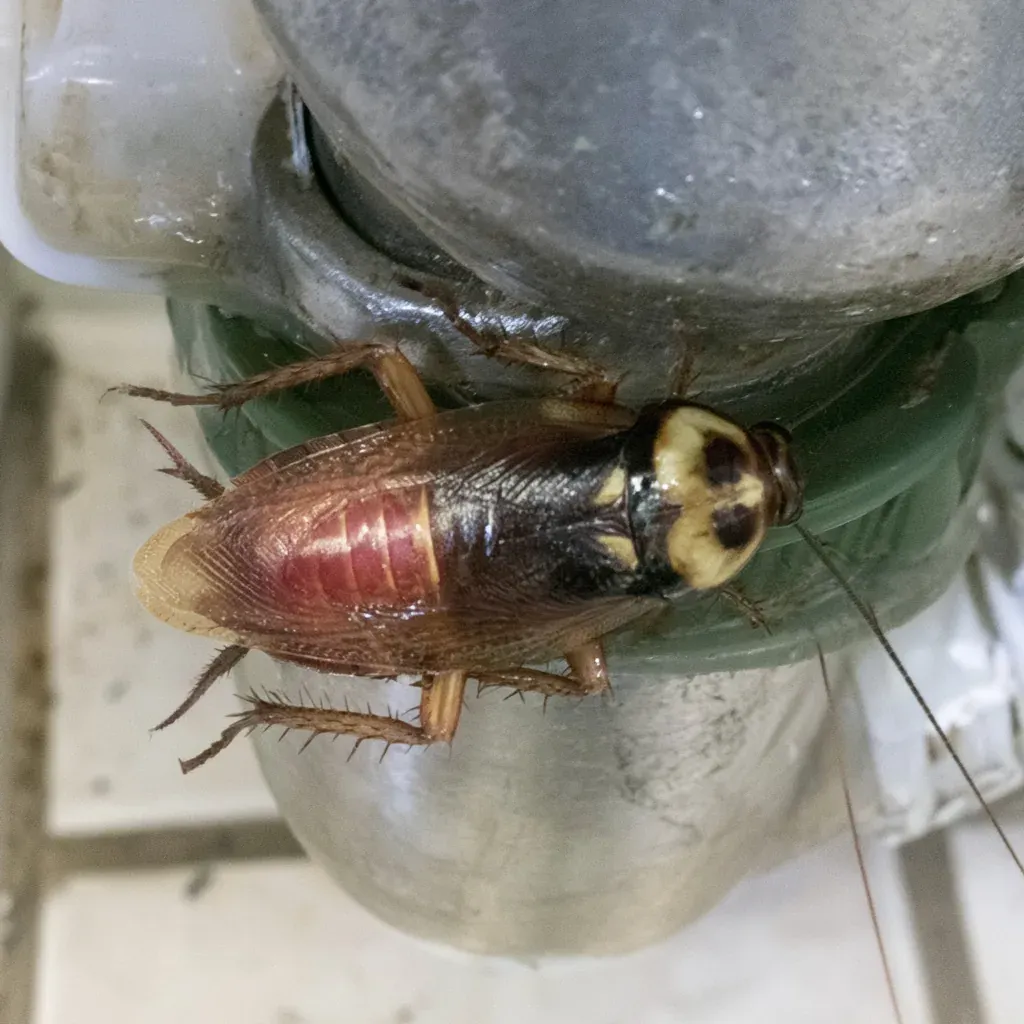
- Reddish brown with a pale yellowish figure-eight marking behind the head
- Flight
- Wings that cover the body, and it will glide down from a height
- Where it lives
- Mulch, sewer lines, storm drains, crawl spaces, meter boxes, tree stumps
- Season
- Present year round outdoors, with indoor sightings clustered around heavy summer rain and again in the first cold snap.
- Typical treatment
- an estimated $95–$275
Or is it something else?
Oriental cockroaches. Oriental cockroaches are also an outdoor and drain species but they are shorter, much darker, close to black, and their wings do not cover the whole abdomen. Both call for exterior and plumbing work rather than kitchen treatment, so mixing them up costs little, though Oriental cockroaches lean harder toward drains and standing water while the American will happily live in dry mulch.
How it gets dealt with properly
The inspection belongs outdoors and underneath. Mulch depth and how close it sits to the siding, downspout discharge, the crawl space vents and access door, the sill plate, the meter box, the sewer cleanout, and every point where a pipe or a wire passes through the envelope. The point of the visit is a list of openings and wet spots, not a count of roaches.
Exclusion is what actually changes the outcome. Escutcheon plates or sealant around pipes under sinks and vanities, a screened cover over open weep holes, a bath trap access properly closed off, a solid crawl space access door, and door sweeps that touch the threshold. Every one of those is permanent, and together they beat any product schedule.
Then a treated exterior band along the foundation, with bait or dust in the crawl space and in the voids the insect uses, cuts the population that is pressing in. Interior spraying gets very little of this species and is mostly wasted, which is why a company that walks straight to your kitchen with a sprayer has misread the job.
The split with american cockroach is simple enough: something contained gets treated once, while pressure arriving from outside every season is what cover is for. There is no winter here that resets it.
Working out which you need
| How it presents |
What that usually needs |
|---|
| One place, one cause, spotted early | A single visit |
| A pattern rather than an incident | Cover through the year |
| Anything set up inside the structure itself | Both: the animal and the hole |
The homeowner side of this
Sealing is genuinely effective homeowner work and it is where to spend an afternoon. A tube of sealant, a couple of escutcheon plates, a new door sweep and a rake to pull mulch back off the brick will do more than a case of aerosol. Trim the shrub that touches the siding and get the downspout discharging away from the wall while you are out there. What does not work is fogging a room. It kills the individual you saw, the source population outside is untouched, and the next storm sends another one through the same gap.
Whether you need to worry
This roach travels through sewer lines, drains and damp soil, then walks on counters, so the real concern is what it carries on its feet and in its droppings onto food surfaces rather than any bite or sting. Droppings and shed skins also add to the allergen load in a house, which matters most for asthma. Practical response: keep food covered, wipe hard surfaces the insect may have crossed, wash anything left in a sink, and treat a sighting as a reason to find the opening rather than a reason to disinfect the whole kitchen.
Before you ring round
Work on american cockroach generally falls in an estimated $95 to $275 band. How long it has been going on decides most of the rest. Having somebody look costs nothing, and you see the number in writing first. See the pricing guide for the complete set of ranges, and this one is handled under Cockroach Control.