Small roaches scattering when the light comes on
Half an inch or less, tan, running for the gap behind the toaster or under the dishwasher panel. Several of mixed sizes at once means a breeding population, not an arrival.
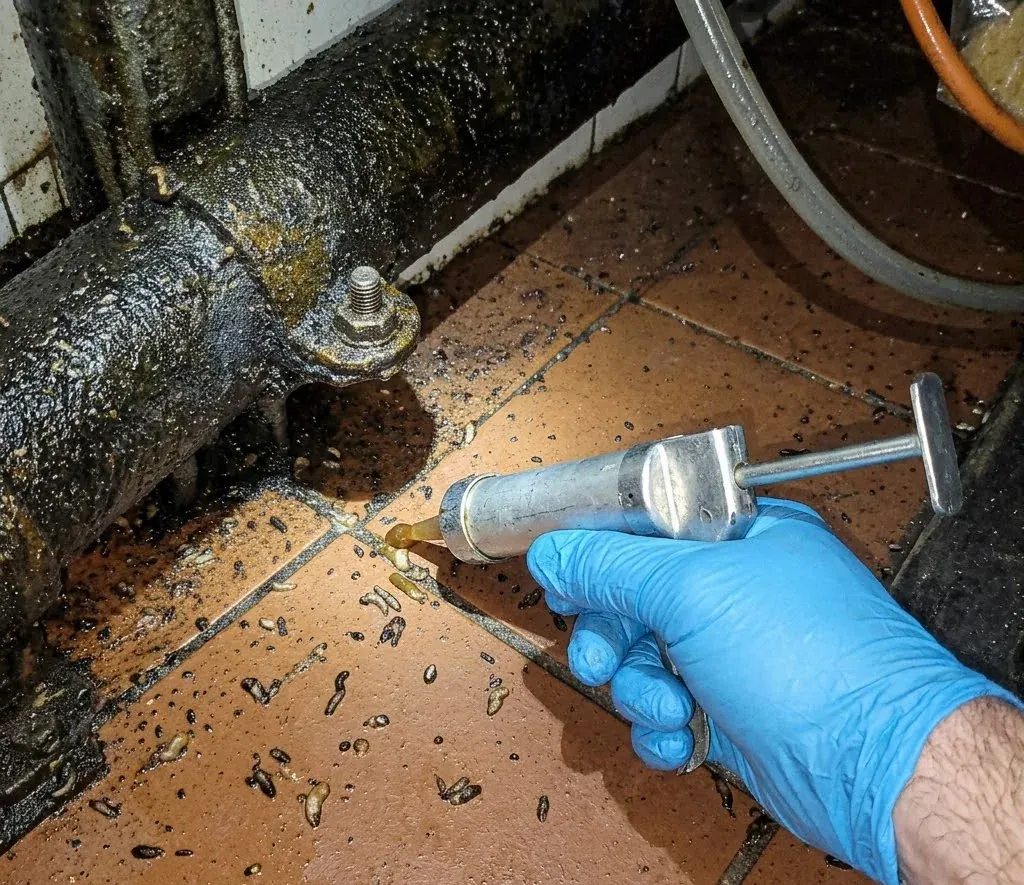
Indoors and breeding all year, since a heated kitchen removes any seasonal pause.
German cockroaches are the one species that breeds indoors, in kitchens and bathrooms, and they rarely walk in from outside. They ride in on grocery boxes, secondhand microwaves, appliance deliveries and moving cartons. Control is gel bait and monitors plus at least one follow-up visit, because eggs hatch after the first treatment. In a duplex or an apartment block, treating one unit while the neighbors go untreated spends money for nothing.
These are the things homeowners spot before they call.
Half an inch or less, tan, running for the gap behind the toaster or under the dishwasher panel. Several of mixed sizes at once means a breeding population, not an arrival.
Droppings collect in the corners of drawers, along shelf edges and around hinges. They look like ground black pepper and they mark the harborage, which is where the bait needs to go.
A small tan capsule the shape of a rice grain, often stuck near a hinge or under a shelf lip. Each one held dozens of eggs, which is the reason a single treatment is never the plan.
How they get in is the same everywhere, and Fayetteville just gives them more chances. They travel in things, not through gaps: grocery and delivery cartons, a used microwave or refrigerator, a restaurant takeout bag, a washing machine bought secondhand, boxes stored in a shared laundry room. Inspecting the outside of the house for entry points is effort spent in the wrong place for this species.
Rental turnover is the local factor that matters. Fayetteville has a large rental market and a lot of movement, and Fort Bragg households move on orders rather than on a lease year, so furniture, appliances and cartons change addresses constantly and at short notice. A property with high turnover can import the same population repeatedly, which is why property managers here treat between tenancies rather than only on complaint.
Shared walls decide whether a treatment holds. In a duplex, a fourplex or an apartment building the population moves through plumbing chases and shared voids, so an untreated neighboring unit is a reservoir. A single-unit treatment can look successful for a month and then be back to where it started, and the money is genuinely wasted. This is the point the Greater Fayetteville Apartment Association audience already understands and individual tenants often do not.
Fayetteville's older duplexes and garden apartments share plumbing walls and stacked kitchens, so one unit's grease-and-crumb buildup can seed cockroaches into three neighbors before anyone calls it in. That same shared-wall pattern shows up wherever older rental stock sits close together, from Godwin down Dunn Road to the farmhouses toward Linden and the tenant housing near Falcon off I-95. The licensed pros we connect you with treat it as a building problem, not a single kitchen's bad luck.
Grease and box stacks aren't the only draw indoors, and Fayetteville's older duplexes share another weakness: shared plumbing chases behind kitchen cabinets that let a population move sideways through a wall without ever crossing an open room. The same layout turns up a drive south at St. Pauls, and again in the vinyl-sided rentals near Roseboro's Howell-Butler House, where landlords often manage several addresses at once. The licensed pros we connect you with know a single treated kitchen rarely holds if the chase itself never gets sealed.
Older plumbing chases follow the same pattern past Fayetteville's edges, in towns built on the same coastal-plain sand. Rental kitchens near Erwin's commercial district and the stretch along the Cape Fear River see the same gap-behind-the-stove infestations, and Lumberton's neighborhoods near Lumber River State Park report identical complaints every summer. Humidity trapped behind cabinetry feeds the colony regardless of the county line, which is why the licensed pros we connect you with treat the gap, not just the roach.
Calls for it come in from all over Cumberland County, Spring Lake, Fort Bragg and Raeford among them.
Young American cockroaches. A juvenile American cockroach is also small and brown and turns up in a kitchen, which sends people down the wrong road. Look for the two dark parallel stripes behind the head, which the German has and the young American does not. It changes the entire plan: stripes mean an indoor breeding population and a baiting program with follow-ups, no stripes mean an outdoor insect and a sealing and perimeter job.
It starts with monitors, not with product. Sticky traps in the kitchen and bathroom, left for a few days, tell you which cabinet, which appliance and which corner carry the population and how large it is. That map is what makes the baiting precise, and it also gives an objective before-and-after rather than an argument about whether things are better.
Gel bait in cracks, in hinges, behind the dishwasher panel and around the motor housings, plus an insect growth regulator, is the core of the work. Bait is carried back into the harborage and passed on, and the growth regulator stops the next generation reaching breeding age. Spraying the baseboards is close to useless against this insect and can push it deeper into voids where bait cannot reach.
The follow-up visit is not an upsell, it is part of the method. Egg cases carried through the first treatment hatch afterward, so a second and often a third visit at two to three week intervals catches the new nymphs. Any quote with one visit and no return is a quote for half a job.
Then a short list of changes locks it in. Repair the leaking supply line, fix the cracked countertop seam and the gap behind the sink, pull the range and clean underneath it, empty and clean the cardboard out of the pantry, and stop storing boxes from deliveries. Cardboard is both food and harborage, and getting it out of the kitchen removes a lot of the habitat at no cost.
Plenty of german cockroach situations are done in one call. What decides it is whether the pressure came from an event or from conditions that are still there.
| How it presents | What that usually needs |
|---|---|
| Something contained, in one part of the property | Treat it once |
| Pressure off the yard or the marsh, year after year | Recurring visits |
| Something living in the crawl space, a void or the attic | Treatment with exclusion work |
If you rent, North Carolina G.S. 42-42 requires the landlord to make repairs and do what is needed to keep the premises fit and habitable, and that duty runs for the whole tenancy rather than only at move-in. It cannot be waived by the lease. That said, do not assume the bill is automatically the landlord's, because who pays turns on the lease terms and on the cause. The practical steps that protect you are the ones the NC Bar's own consumer material gives: report the problem in writing, keep a copy, and keep paying rent while it is being sorted out. Tenant duties sit in G.S. 42-43.
Store-bought gel bait is the same idea as the professional version and it does work in a small, early infestation if you place it in cracks and hinges rather than in open corners, and if you leave it alone. Two things reliably ruin the attempt. Total release foggers scatter the population into wall voids and make the follow-up harder for whoever comes next, and cleaning with a strong degreaser right after baiting removes the bait along with the grease. If you are seeing roaches in daylight, or you share a wall, hand it to the licensed local pros we connect you with and ask for the neighboring units to be included.
The concern with this species is allergens rather than anything dramatic. Droppings, shed skins and egg cases break down into dust that is a recognized asthma trigger, particularly for children in a home with a long-standing population, and a heavy infestation in a kitchen is also a food contamination issue. None of that means panic. It does mean the cleanup matters as much as the treatment: wash down shelves and drawers once the population is knocked back, and get the debris out rather than leaving it behind a kick plate.
Budget an estimated $95 to $275 for german cockroach locally, and treat that as a range to plan against rather than a price. The inspection is free and the scope goes on paper before any work happens. The pricing guide carries the full bands and what shifts them, and the work itself falls under Cockroach Control.
Wood destroying insect. Active most of the year. The eastern subterranean termite is the species behind nearly every termite finding in Cumberland County.
Excavates damp wood. Does not eat it. Carpenter ants do not eat wood.
Many queens. Splits when disturbed. Argentine ants build very large colonies with many queens, and neighboring nests cooperate instead of fighting.
They came in something. A carton, a bag, a used appliance, a piece of furniture, a suitcase. Cleanliness affects how fast a population grows once it is inside, but it does not decide whether it arrives, and plenty of spotless kitchens have had them.
Because egg cases survive the first treatment and hatch a couple of weeks later. Bait keeps working on the nymphs to a point, and the return visit is what confirms it and re-baits where the monitors show activity. One visit with no follow-up is not a program.
Say so when you book, because it changes the plan. The population moves through shared voids and plumbing chases, so treatment on your side alone tends to buy a quiet month. The realistic routes are to get the landlord or property manager to authorize both units, or to accept an ongoing service that holds the line rather than expecting a permanent clearance.
Not wholesale. Discard opened packaging that has been in a cabinet with active droppings, move the rest into sealed containers, and get the cardboard out. Cardboard is harborage as much as it is packaging.
No, and it usually makes the next step harder. Foggers do not reach into hinges and motor housings where these roaches live, and the repellent effect drives them into voids and adjoining rooms. Bait placed where they hide is the method that works.
An initial service with monitors and baiting plus two follow-up visits runs an estimated $120 to $255 for a typical apartment or small home, more for a larger property or a heavy long-standing population. Multi-unit work is quoted on the building. Guide ranges, not a quote.
Book an inspection at no cost. Naming it correctly is what decides whether the treatment holds, and nobody charges you for having a look.
Call (855) 563-1479