Homeowner Tips
The 20 Percent Wood Moisture Rule Explained
One number on an inspection report tells you more about a crawl space than any photograph. Here is what sits behind it…
Read article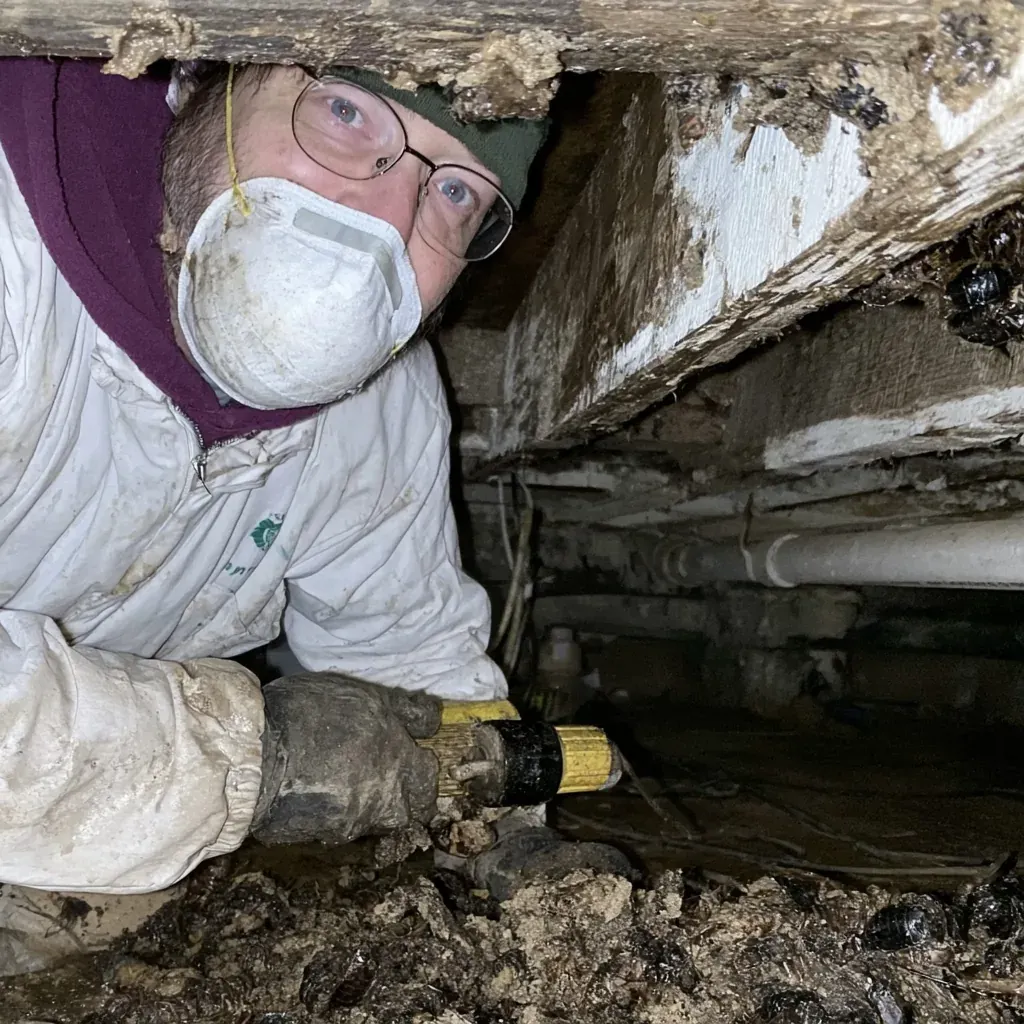
Taped seams, wrapped piers, a curtain wall up the block, closed vents, and a dehumidifier that matches the square footage.
Loose plastic laid over crawl space dirt is not an encapsulation, whatever the invoice calls it. A vapor barrier thrown down in sheets with the edges left open still lets moisture rise through every gap, and once a technician has crawled over it twice it is torn, folded back and holding puddles. The difference is not the material. It is whether the system is closed: seams overlapped and taped, the liner mechanically fastened and sealed where it meets the foundation wall, piers wrapped individually, and a curtain wall run up the block instead of stopping at the dirt line.
The rest of the system is the part people skip. Vents get closed and sealed, usually with foam board, because a sealed crawl space that still breathes humid summer air has nothing to keep out the condensation. Then the space needs a way to stay dry, which is a dehumidifier sized to the actual square footage and to how much water the space produces, with a condensate route that goes somewhere sensible. Undersize it and the unit runs continuously and never wins. That combination, sealed liner and managed air, is why encapsulation is a bigger service line in this market than in most.
Fayetteville sits low along the Cape Fear River, and crawl spaces here run wet more months than dry. The same clay-and-sand mix that pools under a Rockfish rental shows up under slab homes near Eastover, which is why liner and dehumidifier get specified together rather than sold separately. Out toward Stedman, older pier-and-beam houses fail this test first, and it is the same fix every time.
The same moisture problem travels down US 301 and I-95 well past city limits. Near Wade, older homes back up to low ground where a crawl space rarely dries between rains, and the fix is identical to what Fayetteville needs. Drive further to Lumberton, where lots near the Lumber River sit even lower, and the licensed pros covering both routes carry the same liner and dehumidifier setup in the truck before they ever knock.
Whether you're in Gray's Creek, Hope Mills, Spring Lake, or elsewhere around Fayetteville, crawl space encapsulation has to account for sand that drains fast and then holds damp underneath anyway, plus a warm season long enough that nothing gets a proper reset. That is why this outlasts a straight interior spray.
The treatment is the same either way. The scheduling and the paperwork are not: residential pest control for a home, commercial pest control for anywhere with customers or tenants in it.
Old barriers stop where somebody stopped rolling. Sheeting that ends short of the wall, rides up a pier or has been walked through is not doing the job it was bought for.
Water beading on cold metal or wood in a vented crawl space is warm outside air meeting cool surfaces. More ventilation can make that worse, which is the argument for sealing instead.
Air moves upward through a house, so crawl space air ends up in the rooms above. A persistent smell on the ground floor is often coming from below rather than from anything indoors.
Batts that have absorbed moisture pull away and fall out. That is a moisture history you can read at a glance, and it usually means the subfloor above has been damp for a long time.
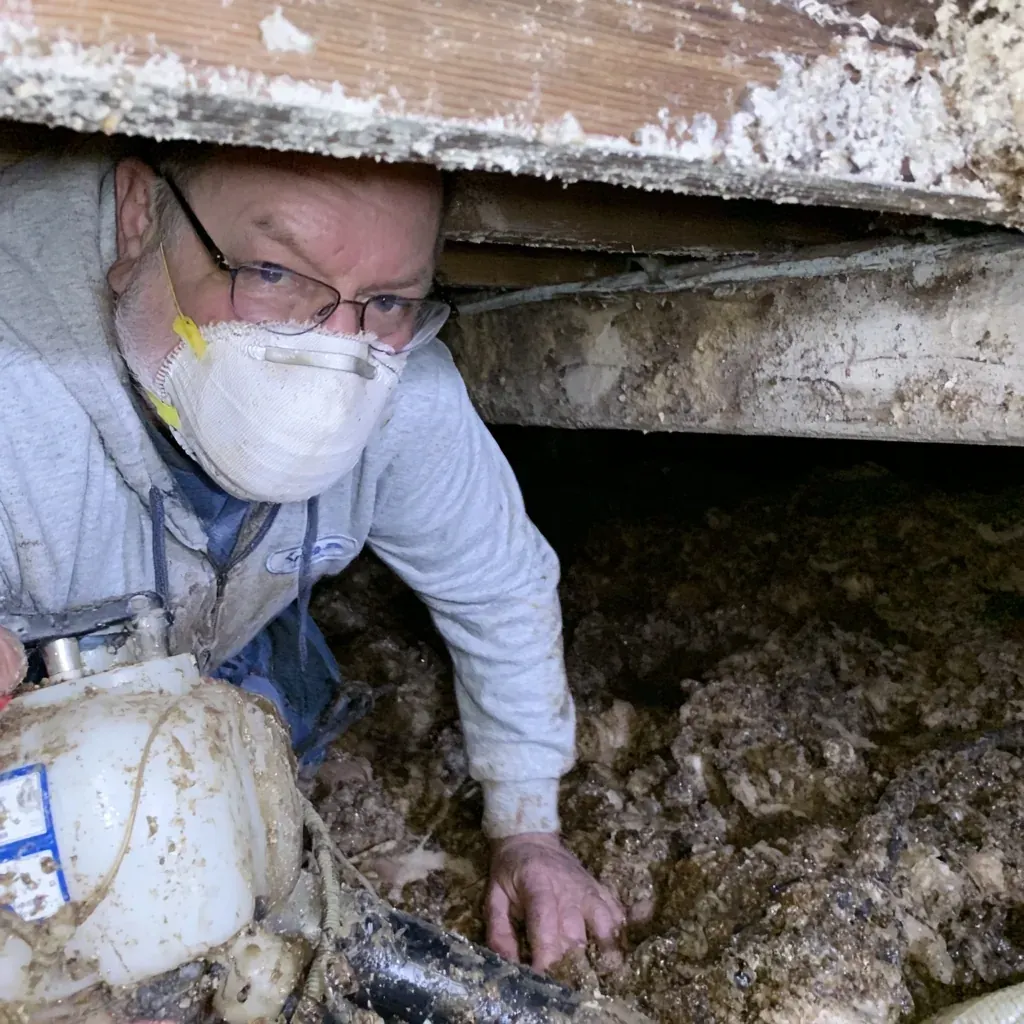
Crickets and roaches gather where it is dampest. A cluster under a bathroom or a laundry points at a plumbing leak that has to be fixed before anything is sealed over it.
Debris and cellulose out, standing water resolved, leaks repaired, and any wood-to-soil contact addressed. Sealing over a wet or infested crawl space just hides it.
Reinforced liner across the soil with overlapped and taped seams, carried up the foundation wall as a curtain wall and fastened and sealed at the top, with each pier wrapped and sealed individually.
Vents are sealed, commonly with foam board, so outside humidity is no longer being invited in. This step is what separates a sealed crawl space from a lined one.
The unit is chosen for the square footage and the moisture load of that particular space, with condensate drained deliberately. Access is left open so the crawl space can still be inspected.
A sealed crawl space changes the conditions under the whole house at once. Framing dries out and stays down at readings that do not get written up as conducive on an inspection report, the insects that live for damp lose their habitat, and the air moving up into the rooms above is drier. It is the most expensive item on this list, so the honest note is that it is worth doing properly once and not worth doing at all as a sheet of loose plastic.
North Carolina's prevention guidance asks for crawl space beams to sit at least 18 inches above the ground so future inspection remains possible, for foundation areas to be kept accessible, and for foundation ventilation to be laid out so dead air pockets do not form. It also calls for annual inspection. An encapsulation designed around those points protects the house and keeps the paperwork straightforward.
Evidence of present and past activity visible in, on or under a structure, or in debris beneath it, is what gets recorded on the official report, and permanently attached decks, porches and storage sheds are included in the inspection. Detached outbuildings are not routinely inspected unless you ask. Where a treatment has been carried out, a copy of the written agreement and warranty has to be attached to the report, so keep the encapsulation documentation and the termite agreement together.
Plan with these rather than quote from them. For crawl space encapsulation, getting at the substructure moves the number further than floor area does, and that is why an honest price does not come down a phone line.
| Which band | What happens | Estimated |
|---|---|---|
| Contained | One live spot, say a run behind a kitchen cabinet or a single mound | an estimated $225–$865 |
| Routine call | Interior placements with the vents, the weep holes and the slab edge | an estimated $265–$1240 |
| Bigger job | A bigger property, or something that has had a season to bed itself in | an estimated $400–$1980 |
| Staged | Something with a history behind it, so several visits and sealing | an estimated $635–$3300 |
Across a year a schedule works out lower per visit than three separate call-backs, and the pricing guide sets the two next to each other with every extra priced.
A vapor barrier is the sheeting on the ground. An encapsulation is a closed system: taped seams, the liner sealed to the foundation wall, piers wrapped, vents closed, and humidity actively managed. Both use plastic. Only one of them controls the space.
In a sealed system, yes, that is the design. Open vents in a Sandhills summer feed humid air onto cool surfaces and produce the condensation you are trying to remove. If vents are staying open, you want a ventilated approach with ground cover and drainage instead, not a half-sealed hybrid.
It is sized to the square footage of the space and to how much moisture it actually produces, not chosen off a shelf. A unit that is too small runs constantly without reaching target humidity, and the running cost lands on you. Ask what capacity is being proposed and on what basis.
No, and it should never be sold that way. It removes conditions that attract them and it makes tubes easier to spot on a light-colored liner, but a sealed crawl space still needs its own termite treatment and its own agreement.
It should not, if the work is done with that in mind. The official wood-destroying insect inspection is a careful visual examination of accessible areas, plus sounding of accessible structural members next to slab areas in contact with masonry walls and other places especially open to attack. Access hatches, walkable clearance and a liner that can be lifted at the wall line keep the space inspectable.
Usually. Crawl space air ends up in the living space, so drier air below tends to mean less musty smell and less clammy flooring above. Treat that as a benefit of the moisture work rather than the reason to buy it.
It is priced by square footage, crawl space height, how much clearing is needed and whether a dehumidifier is included, so figures range widely and most homes land somewhere in an estimated $2,400 to $7,000. That is a guide range for scale only, and no honest number exists before somebody has been under the house.
Use an estimated $265–$825 per treatment as the planning band for crawl space encapsulation in Fayetteville. Three things move it: how much area gets treated, how hard the substructure is to reach, and whether the yard needs covering as well as the building. The visit that produces the exact number costs nothing, and nothing is added to it afterwards.
Worth a read if you are still not certain what you are looking at.
One number on an inspection report tells you more about a crawl space than any photograph. Here is what sits behind it…
Read article
Vents and a hatch, or concrete and a bath trap. Which foundation you have decides how the house gets inspected, treated and…
Read articleSay what you have seen and roughly where it is. You get a straight read on whether this even needs crawl space encapsulation, and a written figure if it does.
Call (855) 563-1479