Why this one turns up here
Sandy ground digs easily and holds a burrow, and every abandoned rodent hole, mole run, hollow under a stump and gap beside a retaining wall is a ready-made cavity a queen can move into. That is why ground nests are so common in Cumberland County yards compared with the visible aerial nests people expect to be looking for.
The season here runs long, which lets a colony reach full size and stay there well into fall. That matters because aggression tracks colony size and the food supply, so the yard that was fine all June becomes genuinely dangerous in late August, right when people are cutting grass, cleaning up beds and using the yard for cookouts.
Ground nests turn up everywhere lawns get regular mowing, and Fayetteville has plenty of that in-ground yellow jacket habitat between clipped turf and untouched edges. In Haymount, older yards near Arsenal Avenue and Cross Creek mix mature landscaping with thin grass that hides entrance holes until a mower finds one. Out toward Hope Mills, properties backing up to Little Rockfish Creek see the same thing along damp, undisturbed banks. A nest that goes unnoticed in June is fully staffed by the time anyone runs a trimmer past it in late summer.
Lawn size plays a role too, and mowing frequency tracks it closely. Bigger lots near Eastover and out toward Stedman often go two or three weeks between cuts in peak summer, giving a ground nest that much longer to grow undisturbed before the mower finds it. Even around Fort Bragg, where turf gets more regular attention, a nest tucked along a fence line or drainage swale in Fayetteville can stay hidden until the blades are already on top of it.
Yard size and mowing habits shift once you leave Fayetteville proper, and ground nests follow that pattern. Spring Lake homeowners with larger lots near Little River often let grass run longer between cuts than a tight in-town yard would allow, and the same goes for properties toward Hope Mills, where mowing intervals stretch out past the Historic District once summer heat sets in. Raeford lots along US 401 show the same gap, giving yellow jackets a longer undisturbed run before the licensed pros we connect you with ever get called.
The same job gets done in Falcon, Godwin and Linden, and everywhere else we cover around Fayetteville.
How to identify it
- Size
- About 1/2 inch, tight bodied and smooth rather than fuzzy
- Color
- Sharp yellow and black bands, narrow waist, dark wings folded along the body
- Nest
- Paper comb inside a cavity: a ground burrow, a wall void, behind siding, in a crawl space
- Behavior
- Stings repeatedly, defends the entrance, and gets more defensive as the season goes on
- When
- Colonies build all summer and peak in aggression from August into the first cool weather.
- Guide price
- an estimated $95–$225
Commonly confused with
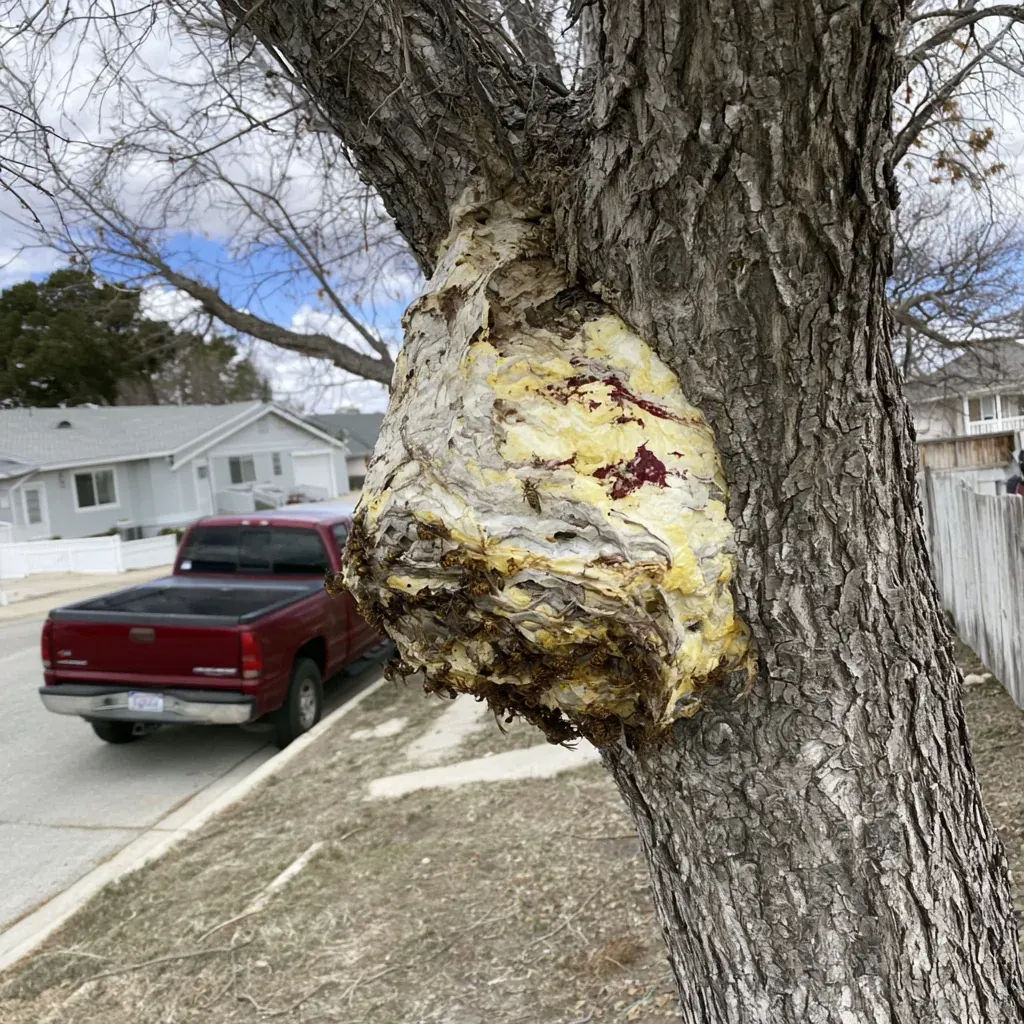
Honey bees and paper wasps. A honey bee is fuzzy, golden brown, and slower, and it is protected and worth relocating rather than killing, so identification changes the entire plan. A paper wasp builds an open umbrella comb you can see under an eave and is far less defensive. A yellow jacket is smooth, brightly banded, and its nest is hidden in a cavity. If insects are going into a hole and you cannot see any comb, treat it as a yellow jacket until somebody confirms otherwise.
What treatment actually involves
Find the entrance in daylight from a safe distance, mark it with a stake or a flag well off to the side, and keep people and pets away from it until the work is done. Do not stand over it. Do not shine a light into it after dark. If it is in a wall void or behind siding, note which room and which wall, because the treatment goes in from the outside and the last thing anybody wants is the colony pushed into the living space.
The treatment itself is a job for somebody in proper protective gear with the right material and the right delivery, because a ground nest has one exit and everything in it comes out that exit. A dust or an appropriately labeled product placed into the entrance gets carried through the nest, which is what reaches the brood and the queen rather than the guards. A follow-up look a few days later confirms the traffic has stopped, and the void or hole then gets closed once nothing is coming out.
For a nest in a wall or behind siding, resist the urge to seal the hole. Closing the only exit on a live colony sends them looking for another way out, which is often into the room on the other side of the drywall. The material goes in first, the colony ends, and the opening gets closed after.
Nobody needs a schedule for a yellow jacket problem with an obvious start and an obvious end. Anyone who says otherwise is working from a sales sheet.
Which of the two your situation calls for
| What you are looking at |
The fit |
|---|
| One place, one cause, spotted early | A single visit |
| A pattern rather than an incident | Cover through the year |
| Anything set up inside the structure itself | Both: the animal and the hole |
The homeowner side of this
The useful homeowner work is all done at a distance: spotting the entrance, flagging it, keeping the family away from it, and walking a new lot before the first mow of the season rather than discovering a nest with the mower deck. Where people get hurt is with a can of aerosol at dusk. The stream falls short of the cavity, the nest is deeper than the product reaches, the colony comes out of a hole you are standing over, and you are retreating in the dark over uneven ground. That combination is how a nuisance becomes an emergency room visit, and it is worth the price of a treatment to avoid.
Health and safety, in plain terms
A sting from this insect hurts more than most and it can be repeated, since one jacket can sting several times and a disturbed nest sends out many. For most people the answer is to move away quickly, wash the site, apply a cold pack, and take a pharmacy antihistamine if the swelling is uncomfortable. What changes the situation is a known allergy, a large number of stings, or symptoms away from the sting site: trouble breathing, tightness in the throat, swelling of the face or tongue, dizziness, or vomiting. That is an emergency, so use an epinephrine auto-injector if one has been prescribed and call 911. If a sting site keeps worsening over the following days, see a doctor. We remove nests. Any medical judgment belongs to a clinician.
Roughly what it runs
A yellow jacket job around here tends to sit between an estimated $95 and $225. Which end depends on the house rather than on the insect. Nobody charges you for the looking, and the figure is written down before a technician starts. Every band, and what pushes it up, sits on the pricing guide, and the service covering it is Wasp Nest Removal.