A cluster of them in one crawl space corner
They do not spread evenly. Twenty in the corner nearest a leaking hose bib or a blocked foundation vent, and almost none at the dry end, is a map of where the moisture sits.
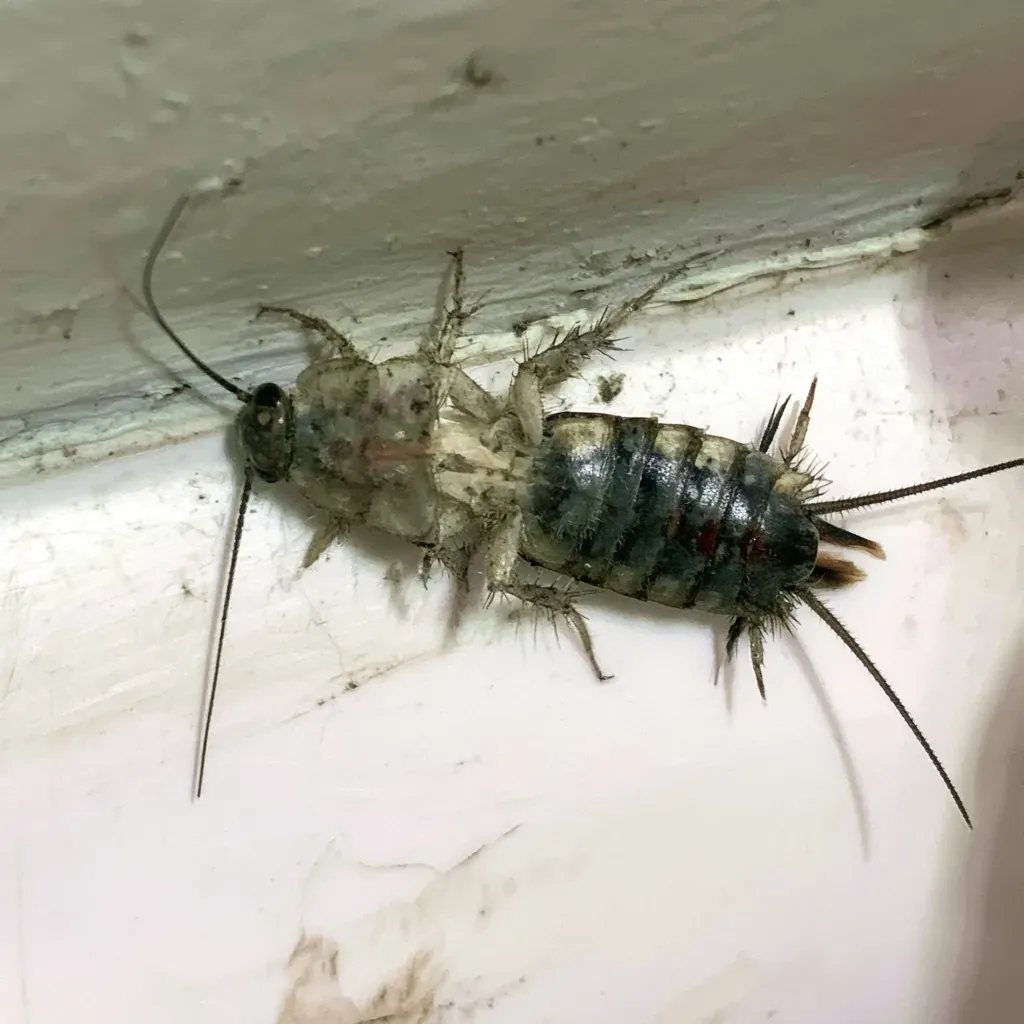
Numbers build through late summer and fall, and a damp crawl space keeps them going all winter.
Camel crickets are a humidity reading more than a pest problem. They gather in crawl spaces, garage corners and stair wells because those places hold damp air, and finding dozens of them tells you the space is wetter than it should be. They do not bite and they do not attack framing. The lasting fix is a vapor barrier, working vents and better drainage, not a spray along the sill plate.
You will normally see the evidence before you see anything moving.
They do not spread evenly. Twenty in the corner nearest a leaking hose bib or a blocked foundation vent, and almost none at the dry end, is a map of where the moisture sits.
This is what makes people call. A camel cricket has no aim, so a startled one launches toward the disturbance rather than away from it, and half a dozen doing it at once in a garage at night is unnerving even though nothing about it is dangerous.
Droppings collect on the tops of boxes and on anything flat left in the crawl space. Chewed cardboard edges and pale grazed patches on stored fabric usually turn up on the same items.
Sand takes a downpour straight down and then holds it in the layer just below the surface, where it slowly turns to vapor and rises into whatever is above it. A crawl space with bare soil on the floor sits directly over that, so the space runs humid in a yard that looks dry an hour after the storm passed.
The crawl space stock around Cumberland County shows the same three faults over and over: poly that was laid loose and has since been dragged into folds, foundation vents grown over by ligustrum or blocked by a mulch bed, and an access door that no longer seats against its frame. Each one raises the humidity a little, and camel crickets read that better than any of us do.
There is a reason moisture control is a named service line here rather than a footnote. Local companies sell poly ground cover, vent work and encapsulation as their own category, and the reason is that the ground under a Sandhills house behaves the way it does. Camel crickets are simply the most visible symptom of it.
That same crawl space moisture shows up a drive away, too: the flat ground toward Wade and the sandy lowlands near Erwin along the Cape Fear River hold water under a house just as long as anything in Fayetteville does, and pros working that stretch report camel crickets for the same reason. Lumberton's older blocks near the Lumber River see it as well. Wherever the ground stays damp under the floor joists, the crickets follow, and the licensed pros who work this territory treat the bugs as a symptom worth reading, not the actual problem.
Slab foundations built after the 1970s changed the pattern inside Fayetteville itself, but the older crawl spaces a drive out still tell the real story. Near Parkton, low ground south of town keeps that dampness pinned under the joists most of the year, and the same holds around St. Pauls off Exit 33, where ditches beside Broad Street rarely dry out between storms. The licensed pros we connect you with read the crickets as a map of where that moisture sits, not a problem to spray away.
The same low-lying pattern shows up wherever crawl space vents sit close to grade, and that stretches well past Fayetteville. Out toward Eastover, ditch lines near the Cape Fear bottomland stay soft into early summer, and camel crickets cluster there the same way. Near Spring Lake, the low ground around Little River keeps foundation vents damp long after a storm passes. Rockfish, along Stewarts Creek, shows the identical reading on sandier soil.
The same job gets done in Eastover, Stedman and Rockfish, and everywhere else we cover around Fayetteville.
Field crickets. A field cricket is dark, has wings and chirps. A camel cricket is silent, wingless and humped, and it is the silent one that means something. Chirping in the yard is a lawn insect. A silent, hump-backed cricket under your house is telling you the crawl space is holding water vapor, which is a different report entirely.
Take a reading before anybody sells you anything. A moisture meter on the joists and the subfloor, a hygrometer left in the space overnight, and a look at where the poly has pulled apart. Wood sitting at 20 percent moisture or above is a reportable condition conducive to termites in this state, so that reading matters for more than the crickets.
The work that ends it is physical. A continuous vapor barrier lapped and run up the piers, vents that are clear and sized for the space, gutters and downspouts that carry water away from the wall, grading that does not tip toward the house, and an access door that closes. Where the space stays wet after all that, a dehumidifier or full encapsulation is the next step, and that is a fair conversation to have with the licensed local pros we connect you with.
A targeted material at the sill, the piers and around the access door will knock the population down and buy quiet for a while. On its own it is a treadmill, because the space is still producing the conditions. Treat the material as the short term and the moisture work as the actual answer.
The split with camel cricket is simple enough: something contained gets treated once, while pressure arriving from outside every season is what cover is for. There is no winter here that resets it.
| Your case | What we would advise |
|---|---|
| One place, one cause, spotted early | A single visit |
| A pattern rather than an incident | Cover through the year |
| Anything set up inside the structure itself | Both: the animal and the hole |
This is why the crickets are worth paying attention to. On the North Carolina Official Wood-Destroying Insect Information Report, Form WDIR 100, excessive crawl space moisture is a reportable condition conducive to subterranean termites, and so is wood at a moisture content of 20 percent or greater. A crawl space full of camel crickets is very often a crawl space that will generate a conducive-conditions note when the house is sold. Dealing with it now is cheaper than dealing with it during a transaction.
They chew paper, cardboard and natural fiber, so the loss is usually stored goods rather than structure: grazed patches on a box of clothes, ragged carton edges, spotting on linens or on a rolled rug. Store anything you care about off the crawl space floor and in sealed plastic, and keep in mind that the same damp air doing this to your boxes is also working on the joists above them.
Homeowner work pays off here more than on almost any other pest. Cut the shrubs back off the foundation vents, pull the mulch down away from the siding, put a downspout extension on the corner that always stays wet, and re-lap the poly where it has been dragged apart. All of that lowers the humidity and none of it needs a license. What does not work is treating the crickets as the problem. You can vacuum them out every weekend and the space will refill, because you removed the animal and left the reason.
Work on camel cricket generally falls in an estimated $265 to $825 band. How long it has been going on decides most of the rest. The inspection is free and the scope goes on paper before any work happens. The pricing guide carries the full bands and what shifts them, and the work itself falls under Moisture Control.
Named on the WDIR-100 alongside termites. Powderpost beetles bore into hardwood and leave small round exit holes with a trace of fresh, flour-fine frass beneath them.
Bare wood only. Spring into late summer. A carpenter bee hole is unmistakable: a clean circle about half an inch across, drilled into bare wood, with a small cone of pale sawdust on the ground below.
An outdoor insect that visits. American cockroaches are an outdoor insect here.
No. They have no venom, they do not bite people, and they cannot damage framing. The unpleasant part is behavioral, since they jump toward whatever startles them, and the meaningful part is what their numbers say about the humidity in the space they are living in.
They have no real steering. The jump is a panic reflex with no direction attached, so with a flashlight and a person in a low crawl space some of them will inevitably come your way. It reads as aggression and it is not.
It will reduce them for a season. It will not keep them out, because the reason they are there is the air and the soil rather than a lack of insecticide. If a company quotes you a spray with no mention of the vapor barrier, the vents or the drainage, get a second opinion.
Locally, crawl space treatment is published from about $95 as a standalone visit or $55 added to another service, and the pros we connect you with sit a little under that, so an estimated $75 to $135 for treatment. Barrier, vent and drainage work is quoted on the size of the space and what condition it is in. Those are guide figures rather than a quote.
Ring us and describe it. We will tell you what it most likely is and what dealing with it involves, before any money is discussed.
Call (855) 563-1479