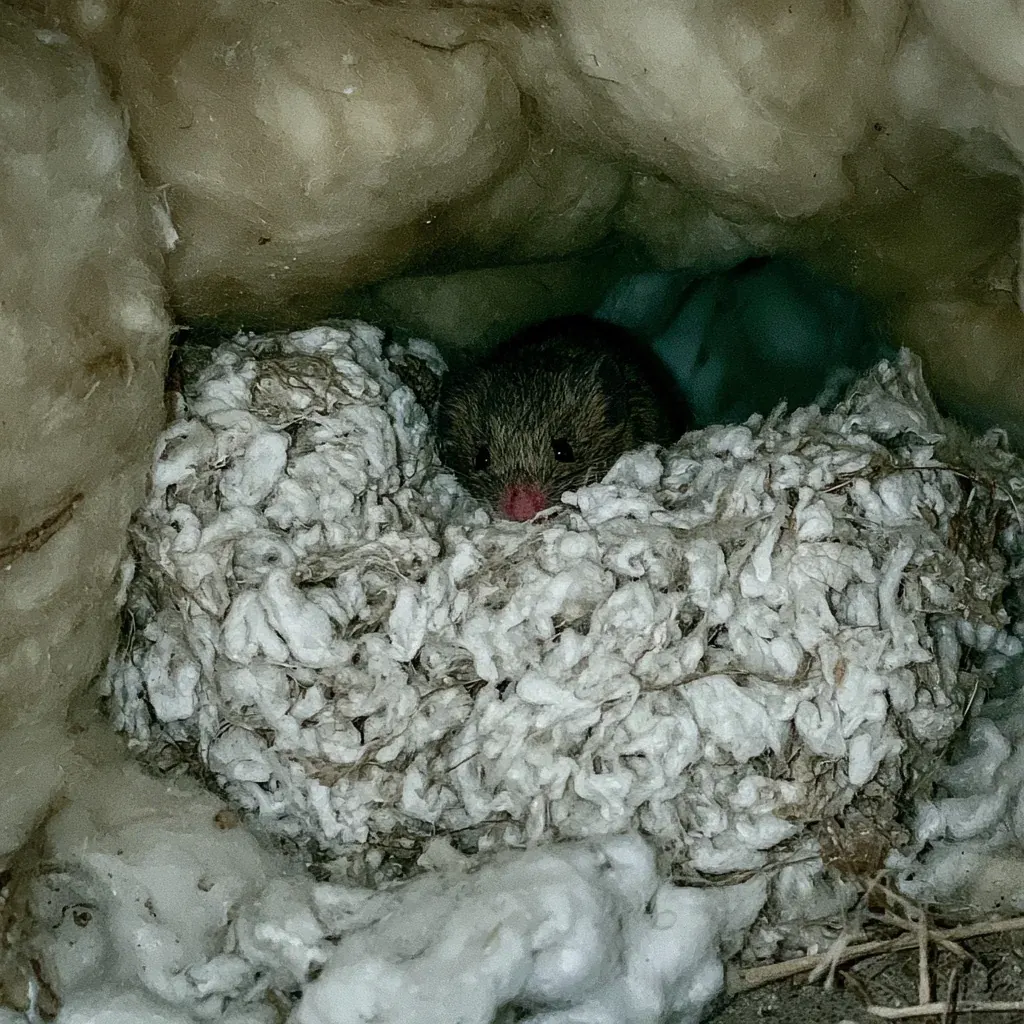
The local conditions behind it
The crawl space and the garage are the two rooms with the most holes in them, and both are common here. Foundation vents with torn or missing screens, an access door that no longer seats against its frame, the gap around a hose bib or a dryer vent, and utility penetrations that were sleeved but never sealed. Once a mouse is in the crawl space it is inside the envelope, and from there the plumbing and wiring chases lead into the kitchen and the laundry.
Sand does something specific at a garage door. It shifts and settles, so the concrete apron ends up slightly low in places and the bottom seal no longer touches across its whole width. A quarter-inch light gap under a garage door is an open door to a mouse, and the garage is usually where the dog food and the bird seed live.
Slab homes are not exempt, they just get in differently. Brick veneer weep holes, the gap where the slab has shrunk back from the foundation wall, a bath trap access left open, and pipe penetrations under a sink cabinet. On a slab there is no crawl space to inspect, so the search moves to the perimeter, the wall voids and the attic, which is where a lot of homeowners never think to look.
Pencil-width gaps are just as common outside Fayetteville proper. In Hope Mills, older homes near the Hope Mills Historic District and along Little Rockfish Creek show the same weep-hole and slab-gap entry points, where damp ground keeps mortar soft and joints loose. The licensed pros we connect you with find identical access spots out toward Eastover and near Spring Lake, close to Pope Army Airfield, wherever brick veneer and slab construction meet older, settled foundations.
The gap doesn't need to be visible to be real, and rural mail chases prove it every fall. Along Broad Street in St. Pauls and out past the old Linden School, older frame houses settle unevenly, opening seams around sill plates that a pencil slides through without resistance. The same houses near Interstate 95 at Exit 33 show mice working in from harvested fields once nights turn cold, well before anyone in Fayetteville notices droppings behind the stove.
Haymount's older homes near the Haymount Historic District carry the same pencil-width gap problem in their foundation vents and door thresholds, and the pattern holds well past Fayetteville. Out toward Vander, metal outbuildings and doublewides sit on piers with open skirting mice climb into by November, while rural stretches near Gray's Creek Elementary School show the same fall push from open fields into house walls. The licensed pros we connect you with check these gaps first.
Linden, Parkton and St. Pauls all see this, and so does the rest of our Cumberland County service area.
Quick identification
- Size
- Body around 3 inches with a tail about as long again, fine and slender
- Color
- Dusty gray brown above, paler underneath, large ears for its head
- Droppings
- About the size of a grain of rice, pointed, scattered along runs
- Gap it needs
- Roughly a quarter of an inch, about the width of a pencil
- Where it lives
- Crawl space, garage, wall voids, kitchen cabinets, water heater closet
- Active period
- Indoors all year, with the sharpest jump as nights cool in October and November.
- Usual range
- an estimated $135–$465
Or is it something else?
A young rat. Size alone will fool you, so look at the proportions. A house mouse has a slender head, large ears and a tail as long as its body, and its droppings are rice sized. A young rat has an oversized head and feet for its body, small ears by comparison, and it leaves noticeably larger droppings. This matters because rats need heavier traps, bigger gaps sealed, and a different search area, so calling a rat a mouse wastes the first two weeks of work.
How the work is done
The first job is mapping, not catching. A technician should come out with the droppings, the rub marks, the nest material and the gnaw damage written down by location, and a list of entry points from a walk around the outside and through the crawl space. If nobody hands you a list of holes, you are buying trapping rather than rodent control.
Sealing is the part that lasts, and the materials matter. Hardware cloth over vents, sheet metal or hardware cloth behind foam at pipe penetrations, mortar or metal at masonry gaps, a proper crawl space door that latches, new screens on foundation vents, and a garage door seal fitted to a floor that is not perfectly level. Expanding foam on its own gets chewed straight through, so it belongs as a filler behind metal and not as the barrier itself.
Trapping and monitoring then clears what is already inside, placed on the runs the inspection identified rather than in the middle of the floor, with follow-up visits to check and reset. Afterward, droppings and nesting material get cleaned out and contaminated insulation replaced, which is as much about odor and food safety as it is about the mice. Keep pet food and bird seed in hard containers with lids while all this is happening, since a food source in the garage undoes a lot of good work.
Plenty of house mouse situations are done in one call. What decides it is whether the pressure came from an event or from conditions that are still there.
A single call against ongoing cover
| How it presents |
What that usually needs |
|---|
| A single event with an obvious source | One call, done |
| Back at the same point every warm spell | A scheduled plan |
| A route in that has clearly been used before | Treat, then seal the route |
Repair and decontamination
The wiring is what should worry you. Mice gnaw insulation off cable to keep their incisors worn down, and chewed wiring in a crawl space or an attic is a genuine fire risk that nobody sees until an electrician is up there for something else. Beyond that: shredded batt insulation, chewed duct board and flex duct that quietly costs you on the power bill, ruined pantry goods, and a persistent stale odor in a closet or a cabinet that does not clear until the nest is found and removed.
What you can do yourself
Homeowners do well at removing the invitation. Pet food and seed into sealed bins, the pantry tidied, the bird feeder moved away from the wall, firewood off the ground and away from the house, and shrubs cut back so there is a clear band of siding to look at. Snap traps set on a wall run with a dab of peanut butter do catch mice, and there is nothing wrong with using them. What does not work is trapping as the whole plan, because an empty house with an open hole in it is simply a vacancy. Also skip the ultrasonic plug-ins, which mice ignore, and be careful with poison in a garage where a dog or a cat can reach it.
Whether you need to worry
Droppings, urine and nest material contaminate the surfaces and stored food they touch, and can carry organisms that make people ill, so the clean-up deserves respect rather than a dry broom. Ventilate the space first, wear gloves and a fitted mask, dampen the material with a disinfectant solution rather than sweeping or vacuuming it dry, bag it, and wash your hands and any surface it touched. Throw out any food in a package that has been gnawed. If somebody in the house is bitten or feels unwell after a clean-up, see a doctor.
The money, plainly
Budget an estimated $135 to $465 for house mouse locally, and treat that as a range to plan against rather than a price. Having somebody look costs nothing, and you see the number in writing first. See the pricing guide for the complete set of ranges, and this one is handled under Rodent Control and Exclusion.