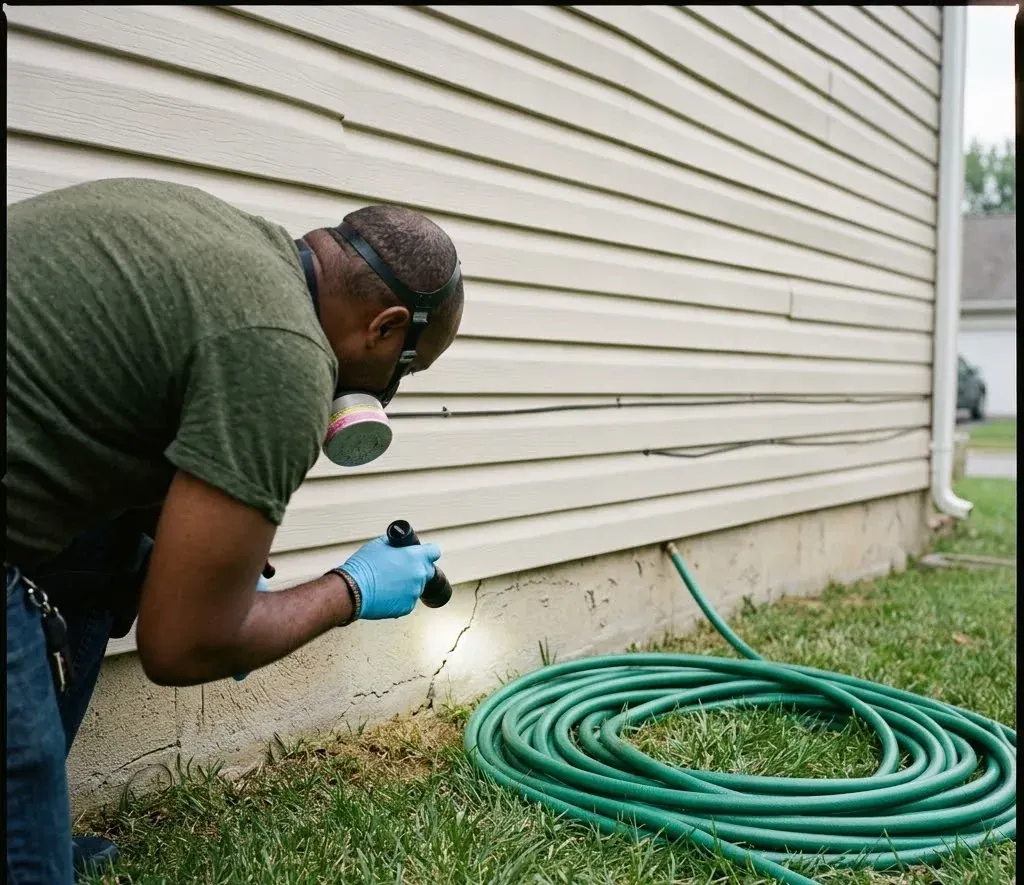
How Much Does Pest Control Cost in Fayetteville, NC?
Published ranges for every service we run, written for the way houses are actually built here: slab or crawl space, sandy Sandhills ground, and a termite swarm window that runs from late winter into autumn.
Expect an estimated $89–$239 for a standard treatment on a Fayetteville house, or an estimated $285–$860 for a year of it on a schedule. One contained room comes in under that. Termite protection, bed bug work and an animal in a soffit come in above it, because each carries documentation and repeat visits. Locally, two things move the figure further than floor area does: whether the house sits on a poured slab or over a crawl space, and how many seasons it has had to run. None of the numbers below are quotes. The visit that produces the real one is free, and you approve it in writing first.
Estimate Your Pest Control Cost in Fayetteville
Pick the service, the scale of the problem, and how soon you need someone out. The tool returns the same guide bands used in the tables below.
Make a selection in all three and the estimated range appears here. If JavaScript is off the menus will not respond, which costs you nothing: the tables on this page carry the identical numbers.
Planning figure only, never a quotation. The real total depends on what the inspection finds, how far activity has spread, and whether exclusion work is needed, and all of that comes to you in writing before any treatment begins. None of your selections are sent anywhere.
What Each Job Costs Around Here
The bands quoted most often across Cumberland County. Anything on a schedule bills per visit, and that per-visit figure sits well under a one-off call because the set-up cost only gets paid once.
| Service | Single visit | Billing basis | A year of it, about |
|---|---|---|---|
| General Pest Control | an estimated $89–$239 | per treatment | an estimated $285–$860 |
| Quarterly Pest Protection | an estimated $79–$129 | per visit | an estimated $255–$465 |
| One-Time Pest Treatment | an estimated $95–$229 | per treatment | an estimated $305–$825 |
| Eco-Friendly Pest Control | an estimated $95–$189 | per treatment | an estimated $305–$680 |
| Termite Control | an estimated $425–$1350 | per treatment | an estimated $1360–$4860 |
| New Construction Termite Pretreatment | an estimated $425–$1350 | per treatment | an estimated $1360–$4860 |
| Moisture Control | an estimated $265–$825 | per treatment | an estimated $850–$2970 |
| Crawl Space Encapsulation | an estimated $265–$825 | per treatment | an estimated $850–$2970 |
| Mosquito and Tick Control | an estimated $69–$139 | per treatment | an estimated $220–$500 |
| Bed Bug Treatment | an estimated $279–$1050 | per treatment | an estimated $895–$3780 |
| Cockroach Control | an estimated $95–$275 | per treatment | an estimated $305–$990 |
| Fire Ant Treatment | an estimated $89–$229 | per treatment | an estimated $285–$825 |
| Rodent Control and Exclusion | an estimated $135–$465 | per treatment | an estimated $430–$1675 |
| Wildlife Removal | an estimated $175–$525 | per treatment | an estimated $560–$1890 |
| Wasp Nest Removal | an estimated $95–$225 | per treatment | an estimated $305–$810 |
One Mound, One Room, or the Whole Plot
Treated area sets most of the price. All four rows below are worked off the same general treatment, so they sit on one basis and can be read against each other.
| Scope | What sits inside it | Budget range | How long on site |
|---|---|---|---|
| Contained: one room, or one mound | A single live spot indoors, or one fire ant mound sitting out in open sand | an estimated $75–$250 | A single call, an hour or so on site |
| Whole house, with the ground line treated | Interior placements plus the slab line or the vents, and soil against the footing | an estimated $90–$360 | A single call, most of a morning |
| Larger footprint, or something living in the walls | A long foundation run to band, more turf to cover, or a colony already in wall voids | an estimated $135–$575 | A day on site and probably one return |
| Structure and grounds, after months of it | Building, substructure and yard on one plan, sealing included, returns staged | an estimated $215–$955 | Split across several weeks |
Some Parts of a House Cost More to Reach
Fourteen inches of clearance over sand that never quite dries is slow, awkward work. So is getting properly at a bath trap under a poured slab, and between them those two account for a good share of Fayetteville jobs. A kitchen, by comparison, is an hour.
| Where the work is | Budget range | Why it prices there |
|---|---|---|
| Kitchens, pantries, bathrooms | an estimated $90–$230 | Easy to get at, so this is mostly time on the drain lines, the pipe collars and the toe kicks where damp gathers |
| Garage, carport, utility room | an estimated $110–$300 | An open door in July, with mulch and pine straw beds a step outside it holding the population already |
| Attic and roof line | an estimated $230–$750 | Hot, cramped and slow. Gray and flying squirrel traffic adds droppings removal and protective kit to the bill |
| Crawl space beneath a raised floor | an estimated $280–$850 | Belly-crawl clearance over sand that stays damp, and usually a torn vapor barrier and open vents to put right too |
| Slab: bath trap, pipe penetrations, slab edge | an estimated $190–$550 | A poured slab shrinks back off the foundation wall and opens the bath trap. Getting at that properly takes patience, not product |
| Wall voids and plumbing chases | an estimated $190–$550 | The hard part is proving where the harborage actually is. Injecting it afterwards is the quick bit |
| Footing line and the outside walls | an estimated $100–$270 | The treated band of soil that stops whatever gets pushed out of the ground when a summer storm fills it |
| Yard, turf, tree line | an estimated $80–$200 | Billed on treated area. Fire ant mounds and whatever is breeding in standing water are dealt with out here |
| Building and grounds as one job | an estimated $290–$1200 | Structure, substructure and outdoor pressure on a single schedule, with the return visits planned in from the start |
Why the House Next Door Got a Different Number
Six things explain nearly every gap between two quotes taken on the same street in the same week.
Linear feet of footing, not just floor area
What gets billed is what gets treated, and on the exterior that is measured along the foundation rather than across the rooms. A compact place off Raeford Road has a short run. A sprawling single story on a wide Sandhills lot has a long one, plus more turf and more tree line, and it sits near the top of the band for that reason alone.
Slab or crawl space, which is not a small difference
Concrete slab on grade is one of the most common builds in North Carolina, and it prices differently from a raised floor. A slab job concentrates on the bath trap, the plumbing penetrations and where the slab has shrunk from the wall. A crawl space job adds clearance, damp ground and vent work, and usually takes longer.
Whether it eats the house or just annoys you
Roaches, spiders and fire ants are routine work at routine prices. Subterranean termites, powderpost beetles, old house borers, bed bugs and animals in a roof line need specialist equipment, documentation and return visits, so they price well above a general service.
How long it has been running
Two roaches in a laundry room is an inexpensive visit. The same population after a full warm season breeding under the floor is a staged job and it costs like one. The termite swarm window here runs from late winter into September, so "I only noticed it last week" and "it started last week" are rarely the same thing.
One call-out against a year-round schedule
A single visit carries the whole set-up cost in one hit. Spread across a plan the per-visit figure drops, re-treatment between visits is covered, and that is why most homes here settle onto a schedule rather than ringing round in a panic every spring.
Termite treatment plus the annual renewal
Termite protection is quoted as the initial treatment plus a yearly renewal that keeps the service agreement and the re-treatment obligation live. Most North Carolina agreements run one year at a time following the initial treatment, and it is priced on its own rather than folded into general pest work.
What the Visit Covers Before Anything Is Quoted
The look costs nothing, and neither does a return between planned visits. Screening, clean-outs and sale paperwork are separate lines. Better you read them here than meet them on an invoice.
| Line item | Budget figure |
|---|---|
| The first visit: walk-round, substructure check, findings in writing | Free |
| Planned visits once you are on a rolling schedule | Included |
| Re-treatment if something reappears between planned visits | Included |
| Reading a termite agreement you already hold, before you renew it | Free |
| WDIR-100 wood-destroying insect report for a sale or a refinance | an estimated $75–$155 |
| Screening and sealing: vents, soffits, pipe penetrations, crawl door | an estimated $150–$650 |
| Substructure or attic clean-out, sanitizing, vapor barrier repair | an estimated $250–$900 |
| New construction pre-treatment, billed per stage against the build schedule | quoted per job |
| Call-out outside normal hours, or straight after a storm | an estimated $75–$150 on top |
Where a North Carolina Policy Stops and an Agreement Starts
A storm that opens a building up may well be claimable. Insects that were always going to turn up are not, and closing that particular gap is the whole reason a termite agreement with damage repair exists as a separate document.
May be claimable
- A storm that tears open a soffit, a gable vent or a ridge and hands wildlife a doorway
- Framing broken by a peril the policy names, provided it is reported and photographed while it is fresh
- Damage an animal does to the building, on some policies, where the entry was sudden rather than gradual
- Removal and clean-up that sits inside a water or storm claim the carrier already has on file
Your bill, not theirs
- The treatment itself, at any frequency. Carriers file pest work under maintenance and always have
- Subterranean termite damage. It is excluded as gradual loss on effectively every homeowner policy, and the document that fills that gap is a service agreement including damage repair, not the re-treatment-only kind most of the trade sells
- Slow moisture and vermin damage under a floor, the kind that took several warm seasons to happen
- Anything a WDIR-100 already recorded before you closed. North Carolina expects evidence on most homes over ten to fifteen years old, so a noted condition is not a surprise to an adjuster
- Rot traced to a leak nobody fixed, a gutter nobody cleared, or flashing left open to the weather
Before you ring your agent, know what the other document is supposed to contain. Any agreement for controlling wood-destroying organisms in North Carolina has to be in writing and has to carry six things: the company name with its license number and phase, a foundation diagram marked active or inactive, the location of any visibly damaged timbers, whether re-inspections happen and how often, the conditions under which a re-treatment is done, and the total price. Those six are what a buyer, an adjuster or a lawyer will ask to see two years from now. Carrier wording varies, so read your own declarations page alongside it.
Four Checks Before You Put Your Name to Anything
Cheap and good value part company quickly in a place where the season barely shuts down. These four are what separate them on paper.
A number given from the driveway
The damp, the mud tubes, the wood moisture and the rodent runs are under the floor, or at the bath trap on a slab. Anyone who prices your house without getting to either has skipped the one place that decides what the job actually is.
Termite work with nothing on paper
North Carolina requires a written agreement carrying the license number and phase, a foundation diagram marked active or inactive, the location of visibly damaged timbers, the re-inspection interval, the conditions for re-treatment and the total price. If a quote is missing those, what you bought was a spray, not protection.
One visit, quoted against a season that never closes
The lowest figure on the table is almost always a single treatment with no follow-up attached to it. Swarming here starts in late winter and is still going in September, so the visit that was left out of the cheap quote is the one you pay for separately later.
A credential nobody offered to show you
North Carolina licenses structural pest control by phase, through NCDA&CS, and the people on the truck are registered technicians, certified applicators or licensees. Certification runs in five-year periods. Ask which phase covers the work you are buying, and ask for the insurance certificate. Anyone doing this properly expects the question.
Our bands sit a little under what the companies around Fayetteville publish, and inside them are the inspection, treatment aimed where the pest is genuinely living, and re-treatment between planned visits at no extra charge. Line three quotes up and compare those inclusions rather than the headline. On termite work compare one more thing, because it is the difference nobody points out: whether each quote is re-treatment only or re-treatment plus damage repair. Re-treatment only is the common form in this trade, and it buys another treatment, not a new joist.
The Same Bands Right Across Cumberland County
One list of numbers from Cross Creek out to the county line, whether the house is a slab in a newer subdivision or a raised floor down near the creek bottoms. Open your town for the part that is specific to it.
Frequently Asked Questions
What should I budget for pest control in Fayetteville, NC?
Put an estimated $89–$239 against a standard treatment on an ordinary Fayetteville house, or an estimated $285–$860 for twelve months of it on a schedule. A long footing run, a big substructure, or a population that has already had a season to settle all push toward the upper end. Treat the figures as planning numbers. The visit that produces the real one is free and the real one is written down before a tank is opened.
What does termite protection cost, and why does it renew every year?
The initial subterranean termite treatment is an estimated $425–$1350. What drives it is linear feet of foundation, how the house is built, and how far the colony has already got. Then the agreement renews, and the renewal is what keeps the inspection and the re-treatment obligation alive rather than being a fee for nothing. Most agreements in this state run one year at a time from the initial treatment, so one that lapses is cover you no longer have. Before you compare two prices, compare the two documents: re-treatment only pays for another treatment, re-treatment plus damage repair pays to put right new damage up to a stated amount, and not every company offers the second one.
Is the inspection really free, and does anybody actually go underneath?
Free, with nothing owed if you decide not to book. And yes, underneath is the whole point. On a raised floor that means the piers, the sill, the ground line and the vapor barrier. On a slab it means the bath trap, the pipe penetrations and the joint where the slab has pulled back off the wall. North Carolina counts wood at 20 percent moisture or more as a condition conducive to termites, so a meter reading is part of it rather than an opinion. You leave with written findings and a band you can hold up against anyone else.
Why does a rolling schedule beat calling somebody each time?
A one-off carries the whole set-up cost on that one invoice. Spread over a schedule the per-visit figure falls to an estimated $79–$129 and a re-treatment between visits is already paid for. The reason it matters more here than in a colder market is the calendar: swarming starts in late winter and runs into September or October, so there is no dead stretch where a population knocks itself back for you.
What does getting roaches under control actually cost?
Most homes land at an estimated $95–$275, and which roach you have changes the shape of the job far more than the price. American and smokybrown roaches live outside and come in under a door, through a pipe collar or up a bath trap, most often in the two or three days after a downpour, so the majority of that work happens outdoors. German cockroaches breed in the kitchen itself and need baiting plus follow-up visits, which sits at the top of the band.
What is a fire ant treatment for a whole yard?
An estimated $89–$229 for the yard, billed on the area being covered rather than counted per mound, because the mounds you can see are never all of them. The usual approach is a broadcast bait across the treated area plus direct work on the active mounds. In sand that drains as fast as it does out here, mounds move and reappear, which is why the broadcast half matters.
What do mosquito and tick rounds cost across a summer?
An estimated $69–$139 a visit, repeated through the warm months because that is what the biology requires, not as a way of selling more visits. Roadside ditches, creek bottoms and any flat corner of a yard that holds water after a storm keep feeding it from early spring until the nights genuinely cool. The treatment goes onto shaded resting foliage and into breeding water, so what it buys back is usable evenings, not a yard with no insects in it.
What does bed bug work cost in a rental or an apartment?
An estimated $279–$1050 for most jobs, set by how many rooms are live and which method fits. Heat sits at the top. A large share of these calls locally come from property managers and landlords working to a changeover date, and a good many of those dates run on Fort Bragg timing rather than a normal lease year, so say when the unit has to be ready and the schedule gets built around it quietly. In a duplex or a block, treating one unit and leaving its neighbors alone is money spent for nothing.
How much is rodent trapping, and is the sealing billed separately?
Trapping and removal is an estimated $135–$465. Sealing is its own line, generally an estimated $150–$650, covering vents, soffits, pipe penetrations and the crawl door. Sealing is the half that actually ends it. Trapping without it empties the space and leaves the route open, which is why the two get quoted together even though they are priced apart.
Will my homeowners policy pay for any of it?
Not the treatment. Carriers read pest control as maintenance and they always have. Termite damage is excluded as gradual loss on effectively every homeowner policy, and the document meant to fill that gap is a service agreement that includes damage repair, which the common re-treatment-only agreement is not. Sudden storm damage that opens a roof line and lets an animal in is a separate question and may well be claimable, so put it to your own carrier. Either way the work gets photographed and written up, because that is the file an adjuster asks for.
Can you price it over the phone, and does anything get added later?
We can give you a realistic band on the phone once we know the pest, roughly how big the property is, and whether it is a slab or a raised floor. That is normally enough to plan around. The firm number waits for the inspection, because quoting a substructure nobody has looked at is how people end up arguing about an invoice. No call-out fee and no fuel charge, and if something bigger turns up you hear about it before anybody acts on it.
Do the towns outside Fayetteville pay a different rate?
No. One rate card covers Cumberland County and the towns just past the line, including Hope Mills, Spring Lake, Fort Bragg, Raeford, Eastover, Stedman, Rockfish, Dunn, Erwin, Lumberton, Wade, Falcon, Godwin, Linden, Parkton, St. Pauls, Clinton. What moves your figure is the building rather than the address: how it sits on the ground, how much land comes with it, and what turns up underneath when somebody looks.
Want the number for your own house, not a band?
The visit costs nothing. The substructure gets looked at properly, crawl space or bath trap, and the figure comes back in writing for you to approve or walk away from.
Call (855) 563-1479