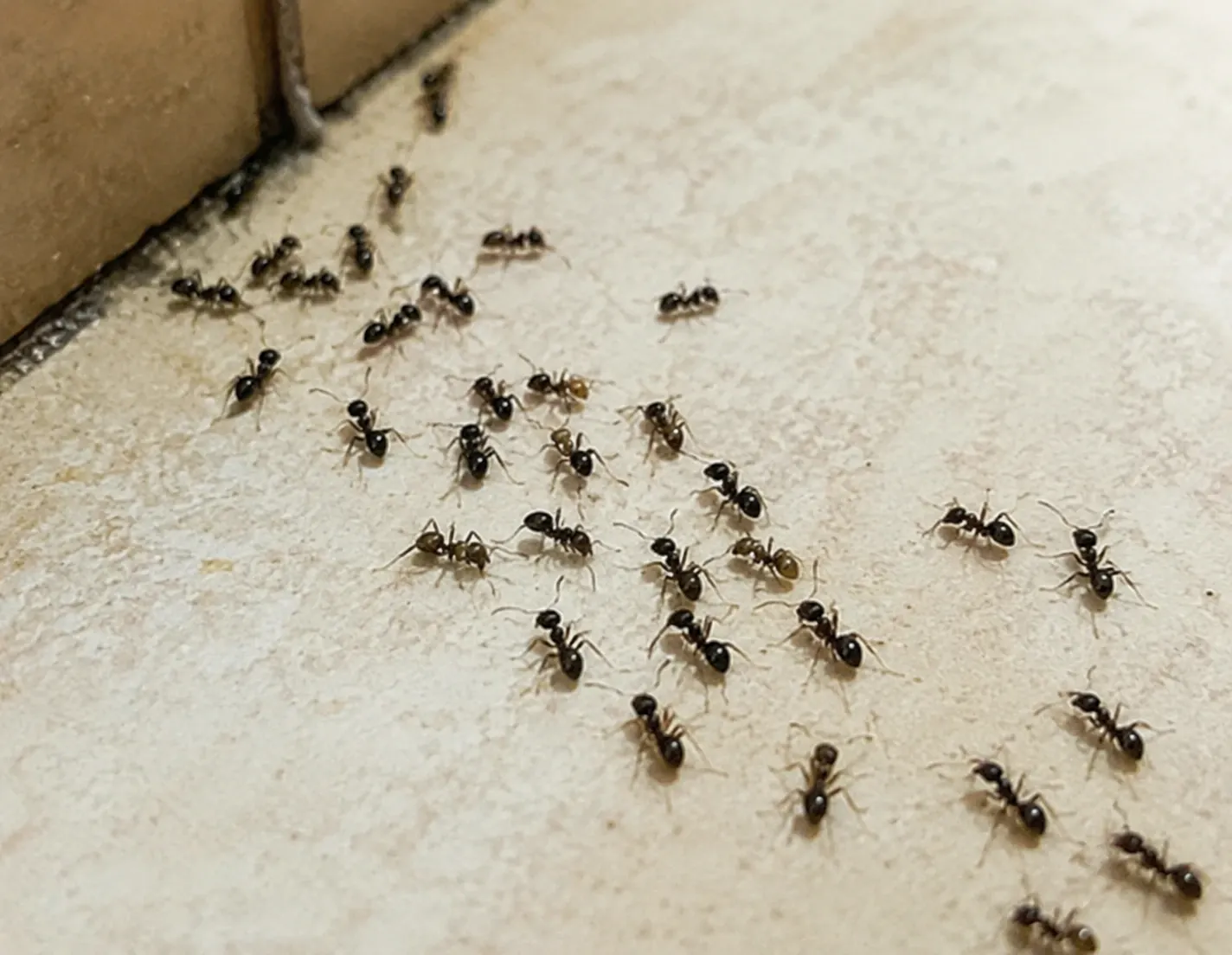
Why this keeps happening in Fayetteville homes
The nesting habit fits local landscaping almost too well. These ants keep shallow nests just under whatever holds a little moisture: pine straw and bark mulch against the foundation, the sand bed under pavers and a walkway, landscape timbers, the saucer beneath a potted plant on a patio. Sandhills soil that dries at the surface and stays damp below means those pockets stay usable through a hot week when open ground does not.
Weather drives the traffic in both directions. A dry spell pushes foragers indoors looking for water, so trails appear in kitchens and bathrooms first, and then a heavy storm floods the shallow nests and moves whole sections of colony under siding and into wall voids. The result is a household that reports ants in two completely different seasons and assumes they are separate problems.
In multi-unit housing the scale gets away from people fast. A single colony can run behind the siding of an entire building, so one apartment or one side of a duplex treating on its own is working on a fragment while the rest of the colony carries on. Buildings need a coordinated approach and a plan for the shared exterior, not a series of individual callouts.
Fayetteville's older duplex rows and rental blocks near downtown share brick foundations and mulched beds that Argentine ants trail along without a break, which is exactly why spraying one exterior wall just pushes the colony sideways. The same coordination problem shows up in the county outside city limits, from Vander to Gray's Creek to the rentals along US 401 toward Lillington, where a scattered treatment plan never reaches the whole nest.
Sandy Fayetteville soil drains fast enough that a single mound looks harmless right up until spraying pushes the colony sideways into a slab foundation, and the pattern holds the same out toward Godwin, where a house near Dunn Road tied to Godwin Presbyterian Church has three satellite trails feeding one queen network, or along NC 82 toward Erwin, where roadside edging gives the ants a dry corridor no perimeter spray reaches on the first pass.
Distance changes what a colony can get away with before anyone notices, and Fayetteville sits at the center of a service radius where trail behavior varies by drive time. Out past St. Pauls near Broad Street the lots run wide and mulched, giving trails room to split unseen for weeks, while nearer Clinton's Commercial Historic District the tight brick storefronts push foraging ants straight along foundation seams, and toward Linden's Little River the damp bottomland keeps trails active even in a dry spell.
Homes in Godwin, Linden and Parkton get treated for it on the same terms as Fayetteville itself.
The short facts
- Size
- About 1/8 inch, and all workers in a trail are the same size
- Color
- Light to medium brown, dull rather than shiny
- Colony
- Many queens, and nests that merge rather than compete
- Nest sites
- Shallow soil under mulch, pavers, potted plants, landscape timbers, wall voids near plumbing
- Time of year
- Trails run outdoors from spring through fall and move indoors during drought and again during heavy rain.
- Estimated cost
- an estimated $89–$229
The look-alike worth ruling out
Odorous house ants. Both are small, brown, trail-forming ants that show up on a kitchen counter, and the practical difference is smell. Crush an odorous house ant and you get a distinct rotten coconut odor. Argentine ants give off only a faint musty smell. It is worth checking, because odorous house ants respond to a narrower bait strategy while an Argentine colony needs sustained baiting across a much wider area.
The treatment, step by step
Bait is the whole strategy, and it needs to be generous and left undisturbed. Liquid or gel bait goes in at the trails and near the moisture, foragers feed and carry it back, and it moves through the colony to queens in nests you never located. Expect trailing to look worse for a day or two as recruitment picks up, then to fall away. Cleaning the trail with a strong cleaner or spraying it partway through undoes the work.
Around that sit the changes that matter more than any product: pull mulch and pine straw back off the siding, lift potted plants off the slab, fix the dripping spigot and the sweating supply line, cut the branch touching the roof, and keep a treated band on the foundation rather than the kitchen. Argentine ants live outdoors and visit, so the exterior is where a program either holds or fails. If a company offers to spray the trail and be done, ask what happens in two weeks.
Whether argentine ant wants ongoing cover comes down to the cause. Fix a route in and it is a job. Leave a damp crawl space and it is a season.
Deal with it once, or keep it dealt with?
| How it presents |
What that usually needs |
|---|
| A single event with an obvious source | One call, done |
| Back at the same point every warm spell | A scheduled plan |
| A route in that has clearly been used before | Treat, then seal the route |
The homeowner side of this
Two things a homeowner can do beat anything sold in a bottle: find the water and stop wiping the trail. Sealing the gap where a pipe enters under a sink, moving mulch off the brick, and letting a bait station sit untouched for a week will out-perform a perimeter spray by a wide margin. The classic mistake is understandable and expensive: spray what you can see, feel satisfied, then discover the colony has budded into two or three new locations and the trails now run through rooms that were previously clear.
What you would be spending
Argentine Ant normally comes in somewhere from an estimated $89 to $229, with access under the floor moving it as much as anything. Nobody charges you for the looking, and the figure is written down before a technician starts. Every band, and what pushes it up, sits on the pricing guide, and the service covering it is General Pest Control.