Two of the most common calls that start with the words "there is mud on my wall" have completely different answers. One is a solitary wasp that will be gone by autumn and has never damaged a building. The other is a covered walkway built by insects that eat the building.
They look similar enough in a photograph that guessing is reasonable. In person they are easy to separate.
A mud dauber nest sits on the surface
Mud dauber nests are stuck onto a surface and stand proud of it: under a porch roof, on the sheltered side of a shed, on a ceiling in a carport, sometimes on brick. They often look like a row of finger-thick tubes laid side by side, or a rough gray lump the size of a small fist.
They are built downward from somewhere dry and overhead, and they are usually somewhere you would describe as sheltered rather than somewhere you would describe as hidden. A mud dauber is a solitary wasp and is not defensive in the way a paper wasp or a yellow jacket is.
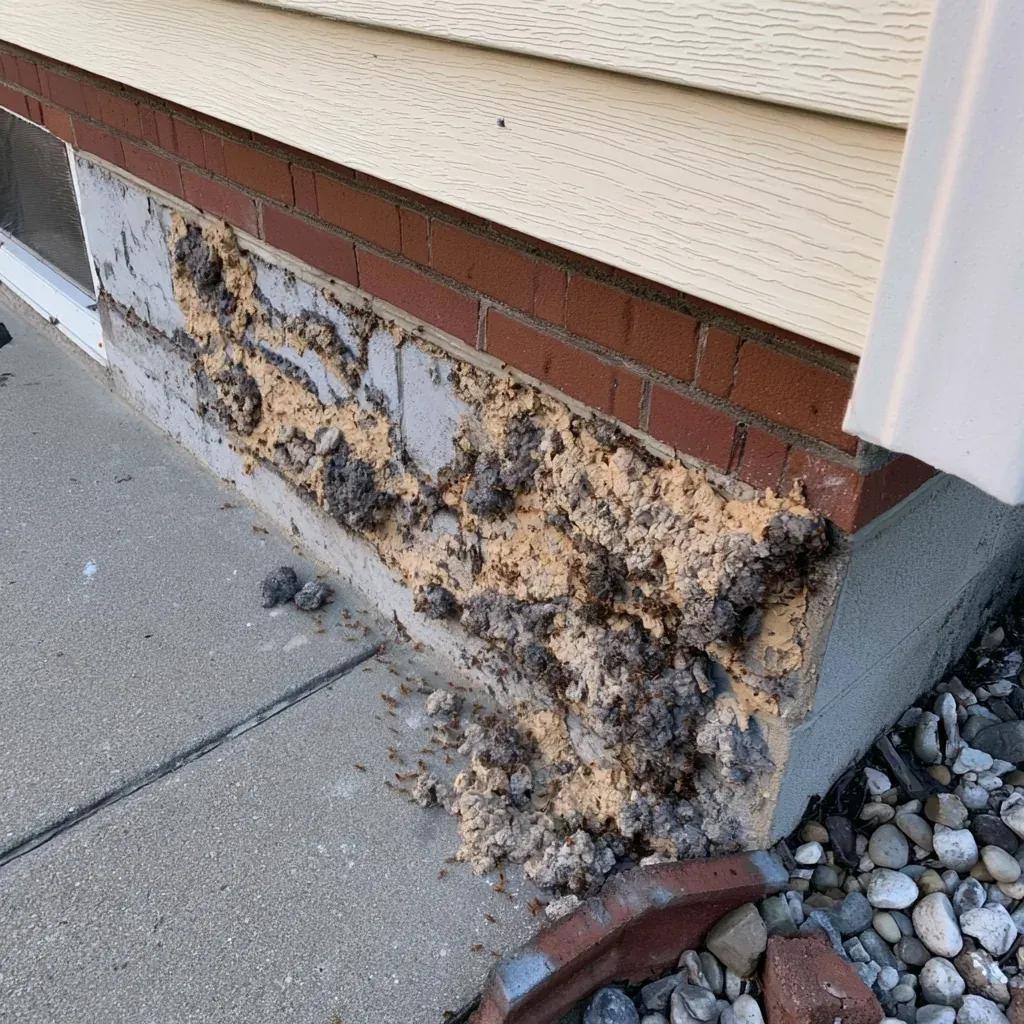
A termite shelter tube runs along a surface
A termite tube goes somewhere. It runs up a pier, along a foundation wall, across the inside of a block course, up the side of a plumbing riser, or down from a floor joist. It is flat rather than round, roughly the width of a pencil, and it is following the path from soil to wood because the insects inside it will not cross open air.
The other difference is direction. Daubers build down from above. Termites build up from the ground, which is why the tube almost always has one end at or below the soil line.
The break test, and why it needs a photograph first
Take a photograph before touching anything. Then break a short section out of the middle of the tube with a screwdriver. If pale insects are inside, or if the gap is repaired within a few days, the tube is active. If it is dry, brittle and stays open, it may be old.
Do not scrape the whole thing off. An intact tube tells an inspector the route, and the route is what decides where treatment goes. Somebody who arrives to find the evidence tidied away is working from your description instead of the wall.
How fast a tube can appear
Two numbers make sense of what is otherwise a confusing situation. Termites need a gap of about one thirty-second of an inch to get through, and they can extend shelter tubes at roughly two and a half inches an hour.
That is why a house can be looked at, come back with nothing noted, and show a tube a few weeks later. It is not evidence that the inspection was careless. It is why keeping the ground under and beside the house dry does more for you than any single visit does.
Where to look before you call
On a raised floor over a crawl space, take a light along the piers and the inside of the foundation wall, then look at the sill and the bottom of the joists. Tubes and dark staining show against pale wood.
On a slab, the equivalent places are the bath trap behind the tub, wherever plumbing comes up through the concrete, the joint where the slab has shrunk back off the foundation wall, and the inside face of any block course. Slab on soil is one of the most common builds in this state, and none of those routes is visible from the yard.
What to do about the daubers, if that is what it is
Very little, honestly. They hunt spiders, they do not chew wood, and a nest on a carport ceiling can be knocked off with a putty knife once it is inactive. If a nest is above a door somebody uses constantly, or in a doorway where a child reaches, that is a fair reason to have it dealt with.
The nests do stain, and the mud sits on paint rather than in it, so washing the mark off sooner is easier than later.
And if it is tubes
Then the useful next step is an inspection, and the useful thing to ask for is what was found, where, and whether it reads as active or inactive. That wording is not accidental: North Carolina's own inspection report records present and past activity, so a note about something treated years ago is history rather than an alarm.
The free inspection is worth taking either way. If the answer turns out to be daubers, you have lost an hour and learned where the damp corners of your own foundation are.
Dealing with this in your home?
We offer free inspections and honest recommendations across Fayetteville and the surrounding towns. Call (855) 563-1479 and we’ll help you sort it out.