What is drawing them to your property
Fort Bragg turnover does not run on a lease year, it runs on orders. Households arrive, leave, put furniture into storage and pull it back out again at short notice and at any point in the calendar. Every one of those transitions is a chance for a bed bug to move address, and it means this market never gets the quiet stretch that a normal rental cycle would give it.
A lot of the housing around the installation is apartments, duplexes and townhomes with shared framing. Bed bugs travel along a shared wall, through a common utility chase and under a door. Treating one unit of three while the neighbors go untreated buys about a month, which is why a serious plan starts by inspecting the units on either side and above and below.
Second hand furniture is the other steady route, and it is not a comment on anybody's housekeeping. A couch off a curb, a bed frame from a yard sale, a mattress bought used, a box of donated bedding. The insect has no interest in whether a home is clean, only in how close it can get to somebody who sleeps there.
Fayetteville renters and buyers move used furniture in from every direction, and the same risk rides along whether the piece came from a curb near Godwin, a yard sale out toward Linden by way of US 401, or a swap made off Dunn Road near Wade. Distance never sterilizes a mattress. The licensed pros we connect you with treat an inspection as the first step, not a formality, because stripping the bed first scatters the very insects that inspection needs to find.
Bed bugs travel by suitcase and secondhand furniture, not by property line, which is why a mattress picked up near St. Pauls or hauled back from a motel off I-95 at Exit 65 near Godwin can seed a Fayetteville bedroom weeks before anyone notices a bite. Rentals turning over near Parkton see it just as often. Whatever the source, the fix is the same: leave the bed alone and let the inspection happen first.
Furniture picked up secondhand carries the same risk, and it travels farther than people expect before it lands in a Fayetteville bedroom. A dresser bought off a listing near Roseboro or pulled from a sale outside St. Pauls off Interstate 95 at Exit 33 can sit in a garage for weeks looking clean while eggs wait in the seams. The licensed pros we connect you with check upholstery seams and drawer joints before anything gets carried inside, not after.
Dunn, Erwin and Lumberton all see this, and so does the rest of our Cumberland County service area.
Quick identification
- Size
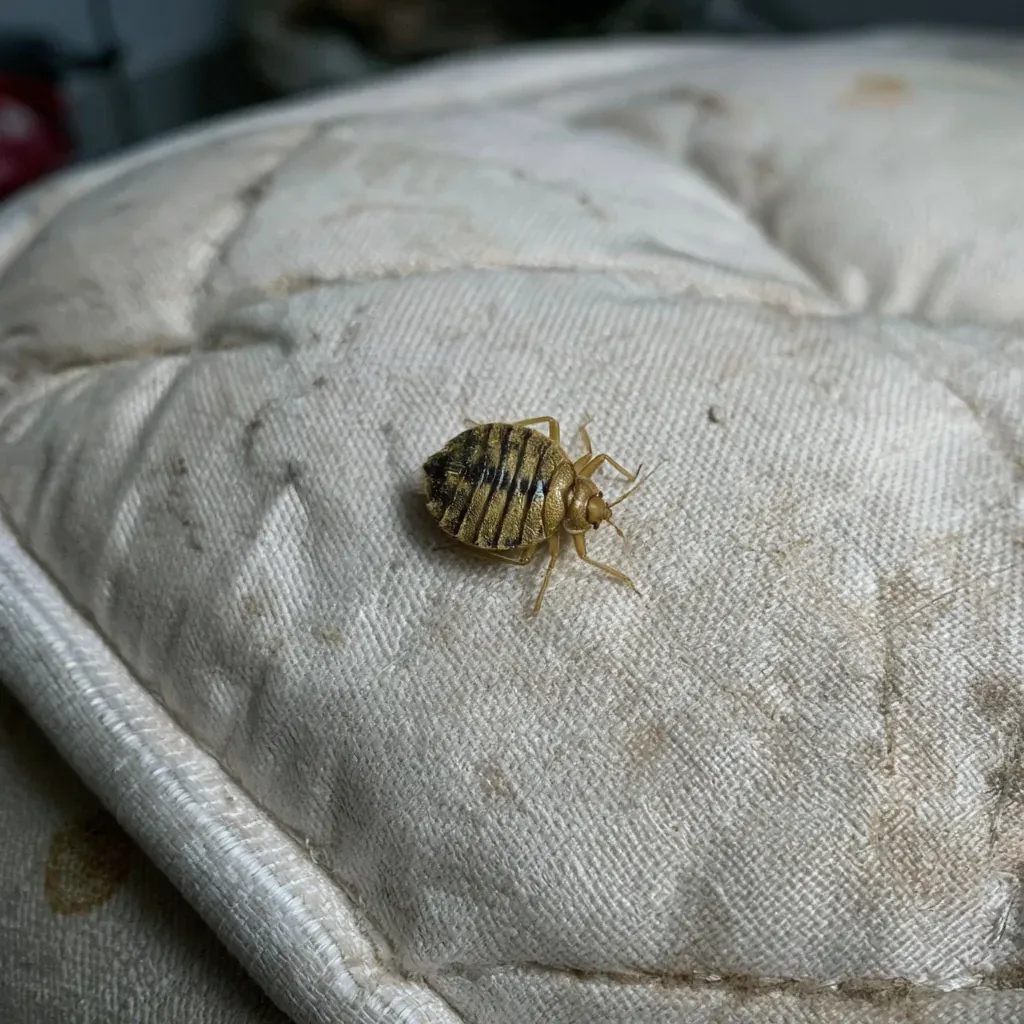
- Adult about 1/4 inch, flat and oval, apple seed for scale
- Color
- Tan to rusty brown, darker and rounder after feeding
- Where they hide
- Within a few feet of where somebody sleeps, in seams, joints and bolt holes
- Active period
- Indoors all year. There is no off season, though moves and travel make late spring and summer busier.
- Usual range
- an estimated $279–$1050
Or is it something else?
Carpet beetle larvae. Carpet beetle larvae also turn up in bedding and also leave shed skins, and they are what a lot of self-diagnosed bed bug cases actually are. The larva is bristly and tapered and it moves slowly in the open. A bed bug is flat, smooth, oval and hides in a seam. One is a laundry and vacuuming job, the other is a treatment plan and possibly a conversation with a landlord, so the identification is worth getting right before anybody spends money.
What happens when someone comes out
The first visit is an inspection with a scope attached, and the scope is often bigger than the room. Mattress and box spring seams, the bed frame taken apart at the joints, the nightstand drawers out and turned over, the recliner somebody has been sleeping in, the baseboard behind the headboard, and in a shared building the adjoining units. Ask for what was found and where, written down. That record is what tells you later whether the treatment worked.
Heat treats the whole room at once and kills every stage, eggs included, in a single visit with no residual left behind. It needs the right equipment, careful monitoring, and items that cannot take heat removed first. Targeted chemical work costs less per visit, reaches into voids and frames, and leaves something behind that keeps working, but it needs two or three visits spaced out because it does not reliably kill eggs the first time through. Neither one is the right answer for every job, and a company that only ever sells one of them is selling its equipment rather than a solution.
Either way, encasements go on the mattress and box spring afterward, monitors go under the bed legs, and clutter around the bed gets reduced so there is less to inspect next time. Laundry on hot and a hot dryer cycle handles bedding and clothing, and the dryer is doing the work, not the wash.
The follow-up visit is not an upsell. It is where you find out whether anything survived in a place nobody opened the first time, and it is where a heat job gets verified as well as a chemical one. Book it at the start rather than deciding later.
Plenty of bed bug situations are done in one call. What decides it is whether the pressure came from an event or from conditions that are still there.
Is this a job or a schedule?
| Your case |
What we would advise |
|---|
| Something contained, in one part of the property | Treat it once |
| Pressure off the yard or the marsh, year after year | Recurring visits |
| Something living in the crawl space, a void or the attic | Treatment with exclusion work |
What the law saysFor renters in North Carolina, the Residential Rental Agreements Act matters. G.S. 42-42 requires a landlord to make repairs and do what is necessary to keep the premises fit and habitable, that duty runs for the whole tenancy rather than just at move-in, and it cannot be waived in the lease. Tenant duties sit in G.S. 42-43. What we will not tell you is that pest control is always the landlord's bill, because it turns on the lease and on the cause. The practical advice from the state's own consumer material holds up: report it in writing, keep a copy, and keep paying your rent while it gets sorted out.
What you can do yourself
There are two things a homeowner does well: laundry and containment. Bedding, clothing and soft items through a hot dryer cycle genuinely kills bed bugs, and keeping treated items separated from untreated ones stops you undoing the work. Where do-it-yourself goes badly wrong is with total release foggers, which push bugs deeper into voids and out along walls into rooms and units that were clean, and with throwing out the mattress before treatment, which usually just spreads the problem down the hallway and costs you a mattress. Also resist the urge to move to the couch. The insect follows where you sleep, and now you have two infested rooms.
The money, plainly
Budget an estimated $279 to $1050 for bed bug locally, and treat that as a range to plan against rather than a price. Having somebody look costs nothing, and you see the number in writing first. See the pricing guide for the complete set of ranges, and this one is handled under Bed Bug Treatment.