What makes local properties attractive to them
Sandy soil is easy digging and it holds a tunnel shape well, and the layer that stays damp below the surface keeps a burrow comfortable through a hot summer. Put that together with the number of properties here that have a shed on blocks, a woodpile on the ground, a compost pile or a backyard coop, and you have both the habitat and the reason to stay.
The corridors matter as much as the yard. Ditches, creek banks and the rough strip behind a row of lots give rats a route between properties that never crosses open ground, so pressure often arrives from the block rather than from anything on your property. That is also why a single treated yard on a street with an ongoing food source somewhere nearby keeps seeing new animals.
Fayetteville sits along travel lines that stretch well past the city limits, and rat pressure follows them the same way. Near St. Pauls, the stretch by Broad Street and Interstate 95 at Exit 33 gives rodents the same ditch-and-shoulder routes into properties, while Clinton's Clinton Depot and College Street Historic District sit close enough to rail and drainage corridors that the licensed pros find matching ground-level activity, not roofline entries, block after block.
Norway rats push south along the same low ground too, out toward Gray's Creek, where drainage running past Gray's Creek Elementary School gives them cover clear to the yard without ever climbing a wall. Elizabethtown sees the identical pattern near Browns Creek, ground activity following water rather than height. In Fayetteville, the same logic holds along any low, damp stretch: check the yard and foundation edges before assuming an attic problem.
Norway rats don't need height to thrive, just a reliable edge to burrow along, which is why the pros who cover Fayetteville also watch the low ground out toward Wade and Godwin, where ditch banks and creek edges run close to the road. Along Dunn Road near Godwin Presbyterian Church, burrow openings show up at fence lines and woodpiles well before anyone spots a rat indoors. Ground signs come first, always.
Calls for it come in from all over Cumberland County, St. Pauls, Clinton and Roseboro among them.
At a glance
- Build
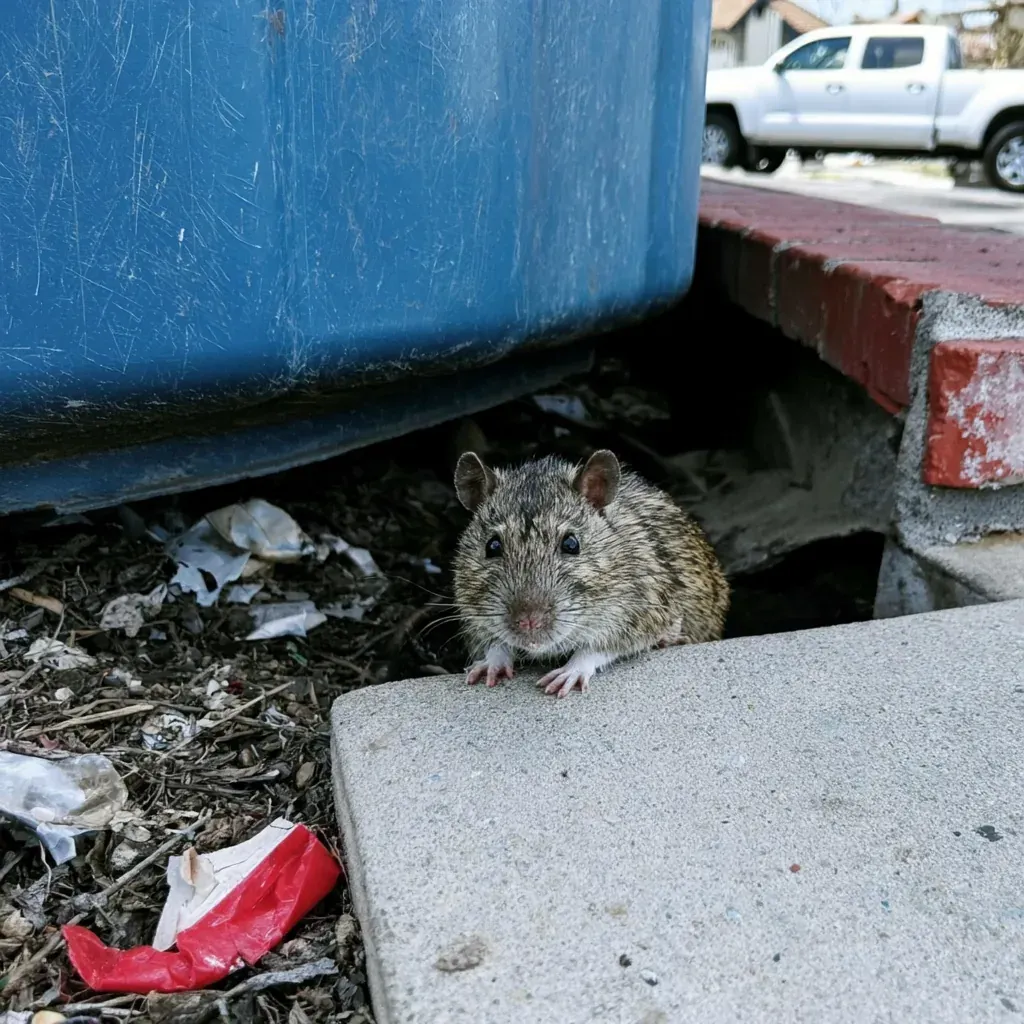
- Heavy bodied and thick, with a tail shorter than its head and body together
- Color
- Brown to gray brown, blunt nose, small ears and small eyes for its size
- Droppings
- Capsule shaped with blunt ends, noticeably bigger than a mouse's
- Habits
- Digs and burrows, travels the same low route nightly, avoids climbing when it can walk
- Active period
- Present all year, with movement toward buildings increasing through fall and any cold snap.
- Usual range
- an estimated $135–$465
Make sure it is not this instead
Roof rat. A roof rat is lighter built with a tail longer than its head and body, larger ears, and a pointed face, and it works high: tree limbs onto a roof, along the gutter line, into a soffit gap or a gable vent. The Norway rat is heavy, blunt faced, short tailed, and stays low. Get this wrong and the crew spends a week in an attic while the animal is living in a burrow under the shed, so the identification sets the entire search area.
What happens when someone comes out
Start by settling which rat it is, because that decides where everything happens. Burrows, low runs, ground level gnawing and short tails point to a Norway rat and the work goes into the ground, the crawl space, the shed base and the perimeter. If the evidence is in the attic and along the roofline, that is a different animal and a different plan, and no amount of burrow work will help.
Control on the ground means heavy traps set in the runs and at burrow mouths, protected from pets and children, or tamper-resistant bait stations where the site calls for it, placed and serviced by somebody licensed to do it. Rats are wary of anything new, so placements often need a few days before they produce, which is why this is a service with return visits rather than a single appointment.
Exclusion is the same principle as with mice but built heavier, since a rat can widen an opening. Hardware cloth or sheet metal at crawl space vents and doors, metal at pipe and cable penetrations, a proper skirt on a shed with the mesh turned outward and buried in an L, and any hollow under a step or a slab closed. Foam and wood alone do not hold against something that gnaws for a living.
Then the food and shelter come out of the yard, because that is what determines whether new rats find the property worth visiting. Firewood up on a rack and away from the wall, compost in a closed bin rather than an open pile, pet food and seed in hard containers, fallen fruit picked up, trash lids that latch, and the dense ground cover along a fence line thinned so a run cannot be made unseen.
Plenty of norway rat situations are done in one call. What decides it is whether the pressure came from an event or from conditions that are still there.
Is this a job or a schedule?
| What you are looking at |
The fit |
|---|
| Something contained, in one part of the property | Treat it once |
| Pressure off the yard or the marsh, year after year | Recurring visits |
| Something living in the crawl space, a void or the attic | Treatment with exclusion work |
What the law saysRodent work on a home is structural pest control, and in this state that means it sits with the NCDA&CS Structural Pest Control Division under the Structural Pest Control Act. Credentials come in three grades: registered technician, certified applicator and licensee, licenses are issued by phase, and certification runs in five-year periods. You are entitled to ask who is doing the work and under what license before anybody places bait on your property, and the division takes complaints and inspection requests on its public line, 984-236-4625. This site is a referral service, so the work itself is carried out by the licensed local pros we connect you with rather than by us.
Repair and decontamination
The digging is the part people underestimate. Burrows run under steps, patio slabs, shed floors and along footings, and over time they wash out and leave a void that shows up as a settling corner or a cracked slab edge. Add gnawed wiring and chewed plastic water lines in a crawl space, ruined insulation, chewed shed siding and contaminated stored feed. Clean-up means removing nest material and soiled insulation, then closing the openings, because a burrow system left open is an invitation to the next animal that comes down the ditch.
The homeowner side of this
The yard work is genuinely yours and it matters more here than with any other rodent, because a Norway rat stays where the food and cover are. Getting the woodpile off the ground, closing the compost, sealing the feed bins and thinning the fence line will move animals off a property without a single trap. Homeowner trapping is harder than it looks: light traps get dragged off, poorly placed ones teach the animal to avoid them, and poison bought off a shelf and put out loose in a yard is a real risk to a dog, a cat and whatever hawk or owl finds the carcass. Do the habitat work yourself and let somebody licensed handle the placements.
What it means for your household
Rats soil what they walk over, so the practical concern is stored feed, a shed bench, a garage shelf or a crawl space where urine and droppings have built up, and the organisms that go with that can make people ill. Wear gloves and a fitted mask, wet the material down with a disinfectant solution before you touch it, bag it, and do not sweep or vacuum it dry. Discard any feed, seed or pet food from a gnawed sack. A cornered rat will bite, so never reach into a burrow or corner one in a shed, and if anybody is bitten or feels unwell afterward, that is a visit to a doctor rather than a question for us.
The money, plainly
Budget an estimated $135 to $465 for norway rat locally, and treat that as a range to plan against rather than a price. Having somebody look costs nothing, and you see the number in writing first. See the pricing guide for the complete set of ranges, and this one is handled under Rodent Control and Exclusion.