The local conditions behind it
Widows want a dry, undisturbed void with insect traffic passing by, and yards here are full of them. Block foundations and crawl space piers, brick veneer weep holes, the hollow under a step, the electric meter box, the gap behind a shed skirt, and the inside of any pot, bucket or watering can that has spent a season on its side. Sandy ground and open sun mean the low, dry, sheltered pockets stay dry, which is exactly what she is looking for.
The other reliable source is anything stacked. Firewood against the wall, pavers left over from a patio job, a coiled hose on the ground, lumber under a deck. Each stack gives her the tight dark spaces and the steady stream of crickets and beetles that keep a web productive, which is why a yard cleanup often turns up several widows in an afternoon when nobody had seen one in years.
Fayetteville yards run heavy on stacked firewood and leftover patio pavers, especially in older neighborhoods where sheds and crawl space vents back up against wood lines, and the licensed pros we connect you with see the same setup on calls out past Stedman and toward Rockfish, where woodpiles sit against outbuildings for months at a stretch. Newer construction near Erwin trades brick foundations for vinyl skirting, but the gap behind it holds a web just as well.
Stacked stone retaining walls around Hope Mills Lake hold the same kind of gaps black widows favor, and the pros who work Fayetteville see it just as often on porch steps in Haymount, where old brick facing has pulled slightly away from its ledge. Woodpiles stacked against a shed near Grays Creek sit undisturbed for months at a time, which is exactly the kind of stillness a widow needs to spin low and wait rather than out in the open.
That same stillness shows up wherever pine straw and rotting trim go untouched, and the pros we connect you with see it as far out as Elizabethtown, Roseboro, and Clinton. Older outbuildings near Tory Hole Park and toolsheds behind homes close to the Howell-Butler House sit low to the ground the same way a carport off a Fayetteville side street does. Sampson Community College's grounds crews report the same web patterns tucked under equipment left idle since spring.
The same job gets done in Stedman, Rockfish and Dunn, and everywhere else we cover around Fayetteville.
How to identify it
- Size
- Female body about 1/2 inch, glossy black, long thin legs
- Mark
- Red or orange hourglass on the belly, sometimes split in two
- Web
- Coarse irregular tangle, unusually strong silk, low down
- Egg sac
- Round, pale tan, papery, about pea size
- Favorite spots
- Meter boxes, crawl space corners, woodpiles, deck rails, stored pots
- Active period
- Adults are found from spring through fall, and a sheltered garage or crawl space holds them over winter.
- Usual range
- an estimated $85–$179
Commonly confused with
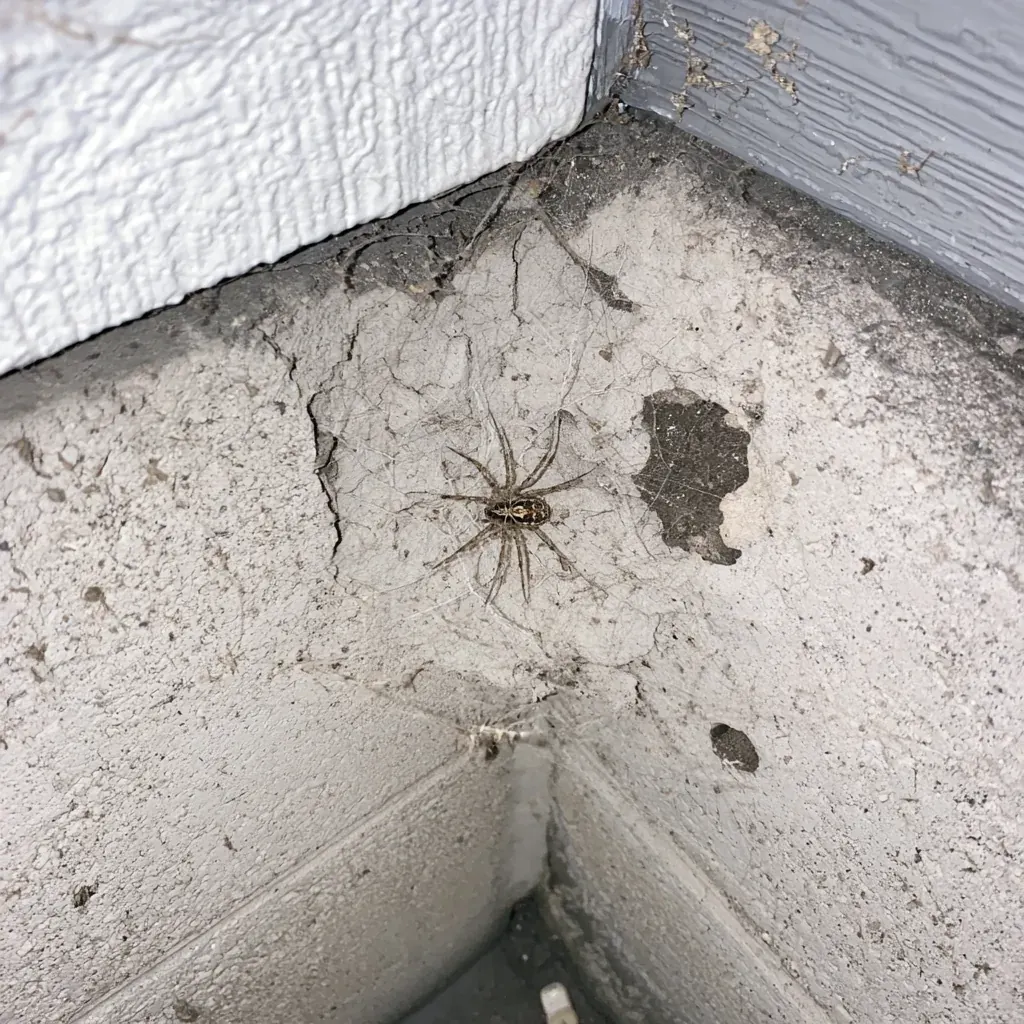
False widow and other dark house spiders. Several harmless spiders are dark, round bodied and build untidy webs, and most of what gets sent to us as a widow is one of those. The deciding feature is the belly mark, not the color of the back. No hourglass and no red at all means you are almost certainly looking at something that cannot hurt you, so photograph it from underneath before you decide.
How the work is done
The honest answer on widows is that this is mechanical work first. Webs get knocked down and removed rather than sprayed and left, egg sacs get taken out of the yard rather than crushed in place, and the voids they were using get treated with a material labeled for that purpose. A web left hanging after a treatment tells you nothing about whether the spider is gone.
After that, the yard gets changed so it stops offering the same accommodation. Firewood up off the ground and away from the wall, stored pots turned upright and stacked inside, a clear band at the base of the siding, and outdoor lighting that does not sit directly over a doorway pulling in the insects she feeds on. Gloves live by the crawl space door and by the meter box, and that habit is worth as much as the treatment.
Plenty of black widow spider situations are done in one call. What decides it is whether the pressure came from an event or from conditions that are still there.
A single call against ongoing cover
| How it presents |
What that usually needs |
|---|
| A single event with an obvious source | One call, done |
| Back at the same point every warm spell | A scheduled plan |
| A route in that has clearly been used before | Treat, then seal the route |
Worth trying before you call
Two homeowner habits do most of the work: gloves before reaching into a dark space, and a flashlight before reaching under something. Knocking down webs you can see with a broom is fine and useful. Where do-it-yourself effort tends to fail is on volume, since a general purpose aerosol in the open air kills the spider it hits and does nothing to the four in voids you did not open, and it never deals with an egg sac. If you have found more than one female, treat the yard as a yard rather than a spider at a time.
Health and safety, in plain terms
A widow bite is genuinely worth taking seriously, which separates her from every other spider in this market. Some bites are barely felt at first and then produce pain that spreads, cramping in the abdomen or the back, sweating and nausea. Children, older adults and anybody with heart problems have less margin. Wash the area, use a cold pack, do not cut it or apply heat, and get to a doctor or an urgent care rather than waiting to see how it develops. If the person is struggling to breathe or in severe pain, call 911. Bring the spider if it is safe to collect, since identification changes what a doctor does. We identify spiders and we treat structures. Diagnosis and treatment of a bite is a doctor's job.
The money, plainly
Budget an estimated $85 to $179 for black widow spider locally, and treat that as a range to plan against rather than a price. Having somebody look costs nothing, and you see the number in writing first. See the pricing guide for the complete set of ranges, and this one is handled under General Pest Control.