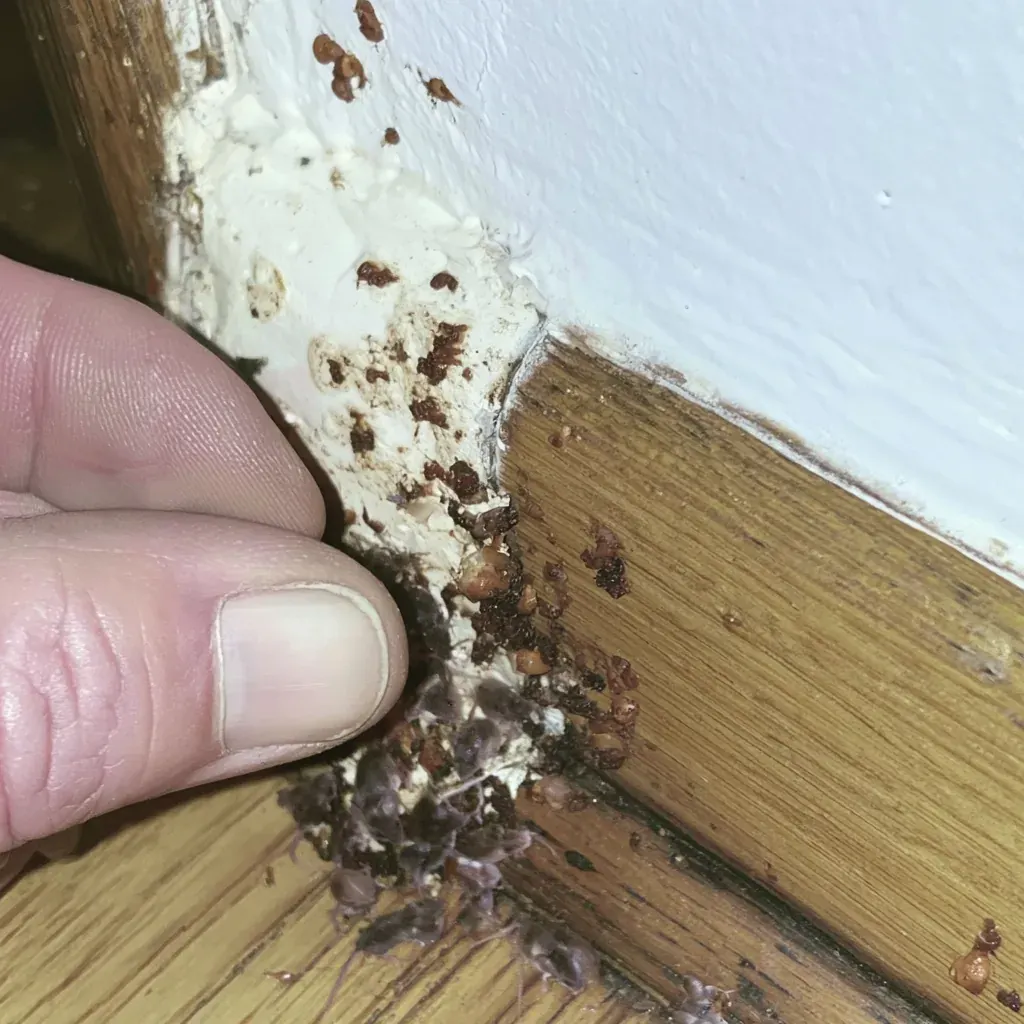
What makes local properties attractive to them
This species needs damp wood, and Fayetteville supplies it in a specific way. The surface soil sheds a summer downpour quickly and then holds damp underneath, so the shady side of a house, the mulch bed against a brick veneer, and the ground under a deck stay wetter for longer than the yard looks like it should. Wood in contact with that ground softens, and a satellite nest in a deck post or a porch column is a short walk from the wall.
The other reliable local source is the roofline. Long, hot, humid summers with hard rain punish flashing, and a slow leak at a chimney, a valley or a shower vent wets the sheathing above a ceiling for months before a stain shows. Nests found in second-floor walls here almost always trace back up rather than down.
Roofline leaks like this are not confined to one side of town: the licensed pros we connect you with trace the same pattern out toward Falcon, where humid bottoms near South River keep old flashing wet, and out along US 301 through Godwin, where farmhouse roofs and porch additions age the same way. Fayetteville's steeper rooflines and downtown chimneys just show the damage first.
The trail runs the other direction too, out US 401 toward Linden, where Ellerslie and Ivy Burne sit under the same old hardwood canopy that keeps porch sills damp long after a storm passes. A carpenter ant colony found near the Dr. Wayman C. Melvin House usually traces back to a gutter seam, not the wood itself. The licensed pros we connect you with check that seam first, because in Fayetteville and out toward Linden alike, the wood is only ever the second problem.
The same seam problem shows up wherever gutters run long without a cleanout, and that stretches well past Fayetteville. Homes along Dunn Road toward Godwin and out near Falcon Tabernacle in Falcon often carry the same style of hung gutter, sagging just enough at the joint to hold water against the fascia board. Even out toward Wade, where older farmhouses line US 301, the ants follow that same wet seam before they ever touch sound wood.
The same job gets done in Rockfish, Dunn and Erwin, and everywhere else we cover around Fayetteville.
How to identify it
- Size
- Workers 1/4 to 1/2 inch, and one colony has several sizes
- Color
- Usually black, sometimes black with a reddish thorax
- Shape
- Evenly rounded upper back and a clearly pinched waist
- Nest sites
- Wet framing, window and door headers, roof sheathing, hollow doors, dead tree limbs
- Season
- Foragers are active from early spring into fall, and winged reproductives appear indoors on warm spring days.
- Typical treatment
- an estimated $89–$229
Commonly confused with
Termite swarmers. This is the single most common misidentification in Cumberland County, because both fly indoors in spring and both come out of woodwork. A winged carpenter ant has a pinched waist, elbowed antennae, and front wings noticeably longer than the back pair. A termite swarmer is straight-sided with no waist, straight antennae, and four wings of equal length. Ants mean you have a moisture problem to chase, termites mean you have a soil barrier and a written agreement to think about.
How it gets dealt with properly
The first visit should be a water investigation with an ant problem attached. Roof edges, gutters and downspout discharge, the shower and tub surrounds, window headers, the deck ledger, any siding within 6 inches of soil, and the crawl space or slab perimeter. Where the wood is wet is where the plan gets written.
Baiting works on this insect and contact spray usually does not. A slow-acting bait taken back to the queen kills the colony, while a fast knockdown along a trail only removes the workers you can see and prompts the rest to divide and relocate. If your trail moved to a new wall two weeks after a treatment, that is what happened.
Non-repellent residual material at the entry points and in the void, applied by somebody who has found the nest, does the rest. Foam or dust into a wall void reaches a gallery that a surface spray never touches, and it is worth asking a company how they intend to get material into the nest rather than around it.
The repair is the part that actually ends it. Replace the softened header or sill, fix the flashing, extend the downspout, cut the shrub back off the siding, and get the firewood off the porch. Carpenter ants will not settle in sound dry wood, so the carpentry is the pest control here.
The split with carpenter ant is simple enough: something contained gets treated once, while pressure arriving from outside every season is what cover is for. There is no winter here that resets it.
Working out which you need
| What you are looking at |
The fit |
|---|
| One place, one cause, spotted early | A single visit |
| A pattern rather than an incident | Cover through the year |
| Anything set up inside the structure itself | Both: the animal and the hole |
The damage and the clean-up
Galleries are smooth-walled and follow the soft grain, and because the ants are working wood that water already ruined, the rot is usually the bigger structural issue. A window header can lose enough section to sag without the ants ever touching a sound board. Repairs are ordinary carpentry, and the sensible order is to dry the area, replace the ruined wood, then treat, rather than treating and leaving the wet timber in place.
What is genuinely worth doing yourself
Following a trail is genuinely useful and costs nothing. Put out a small dab of something sweet, watch which way the workers carry it, and note the wall they disappear into after dark, since this ant forages heavily at night. What backfires is the can of spray on the trail. It reads as a win, the colony buds, and two weeks later you have activity in two rooms instead of one, plus a treatment record that means nothing.
Before you ring round
Work on carpenter ant generally falls in an estimated $89 to $229 band. How long it has been going on decides most of the rest. Having somebody look costs nothing, and you see the number in writing first. See the pricing guide for the complete set of ranges, and this one is handled under General Pest Control.