Why this one turns up here
The ground here sends water somewhere rather than absorbing all of it. Rain on the high sandy spots disappears fast, then collects in the low ground, the roadside ditch, the swale between two lots and the creek bottom at the back of the neighborhood, and those stay wet long after the driveway has dried. Cape Fear bottomland and the creek corridors that feed it hold that moisture through the season, so the pressure in a yard often has nothing to do with anything in the yard.
The other half is how long the season runs. A warm, humid stretch from spring into fall, with afternoon storms that refill every container in the yard on a weekly basis, means the same bucket or clogged gutter produces batch after batch. That is why a single treatment in June has stopped mattering by August, and why the water audit is worth as much as the material.
Fayetteville's shade pattern is not confined to town: the licensed pros we connect you with find the same resting sites near Linden, where tree cover along the Little River keeps foliage damp well past sunrise, and around St. Pauls, where hedges off Broad Street hold moisture the same way. Even out toward Clinton, dense plantings near the Commercial Historic District give adult mosquitoes the same daytime cover. Wherever that shade sits, it earns a barrier pass before the standing water does.
Fayetteville's mosquito pressure runs heaviest near slow-moving water, and the same holds true where the pros we connect you with work west along I-95 toward Lumberton, where the Lumber River State Park tree line keeps its banks shaded through the hottest part of the afternoon. Luther Britt Park sees a similar pattern, with dense canopy holding humidity long after nearby lawns have dried out. That shade-first logic decides where a barrier treatment lands before anyone even checks a birdbath or a clogged gutter for standing water.
Hope Mills Lake tells the same story from a different angle, where the dam holds water back and the trees along the bank never fully lose their dampness, even in a dry week. Spring Lake sits under similar cover near Fort Bragg, where mature stands of pine break up direct sun across whole streets. The pros who cover Fayetteville and both towns look for that overlap of shade and moisture first, since it holds mosquitoes long before a yard's containers ever come into question.
We deal with this across Fayetteville and the surrounding towns, Erwin, Lumberton and Wade included.
Know what you are looking at
- Size
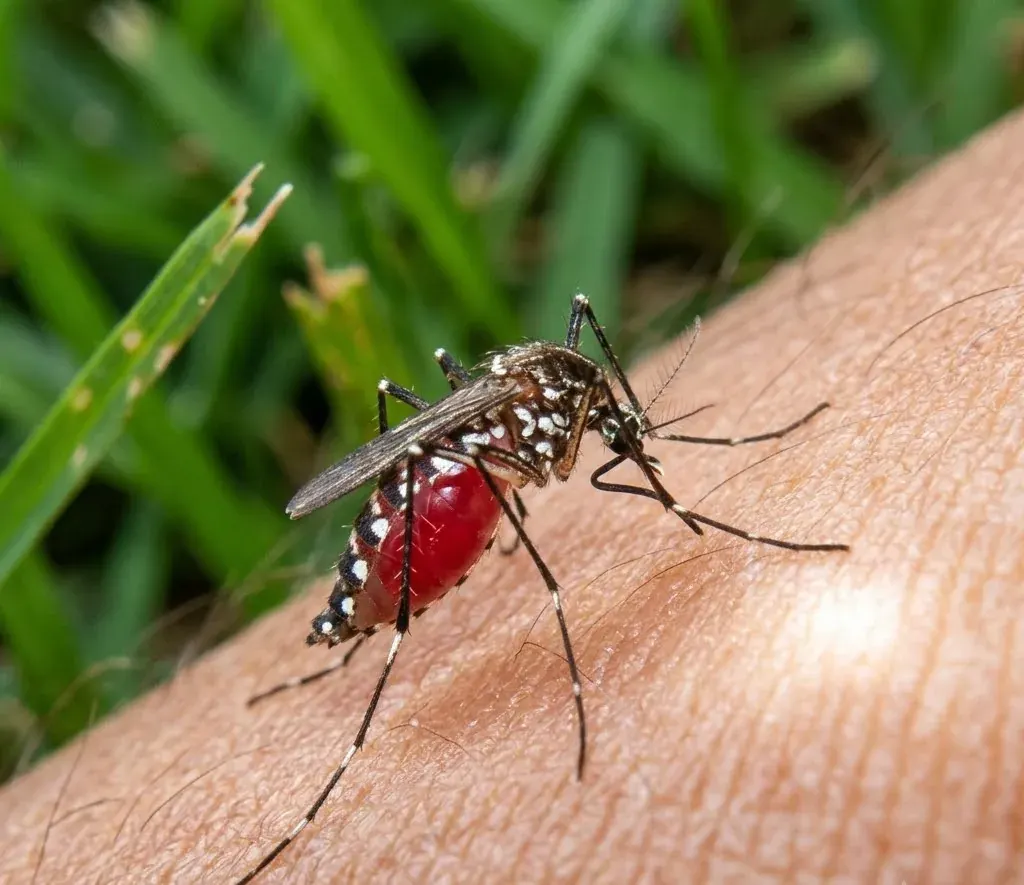
- Around 1/4 inch, long legs, narrow wings
- Biting hours
- Most species at dusk and dawn, and some will bite all day in deep shade
- Daytime rest sites
- Undersides of dense foliage, ivy, tall grass, shaded walls and structures
- Water they need
- Anything standing about a week, including containers you would not call standing water
- Time of year
- Roughly April into October here, with the worst of it after summer storms and through a warm, wet September.
- Estimated cost
- an estimated $69–$139
What it gets mistaken for
Midges and crane flies. Crane flies are the long-legged insects that drift in through a door and cannot bite anything. Midges swarm in columns at dusk over damp ground and mostly do not bite either. Both get blamed for mosquito bites, and both are a reason to identify what you are actually dealing with before paying for a yard program aimed at the wrong insect.
What a professional job looks like
A proper visit walks the property first and writes down the resting sites: the hedge line, the ivy bank, the shaded fence, the underside of the deck, the strip behind the condenser unit, the woodline edge. The material goes onto those surfaces, where mosquitoes will actually be sitting for the next several weeks, and it goes on with a machine that pushes it into foliage rather than over the top of it.
Water that cannot be dumped gets handled differently. A drainage box, a low spot that holds after every storm, a rain barrel, a decorative pond, the corrugated pipe under a driveway: those take a larvicide instead. Water that can be dumped should simply be gone, and a checklist taped inside the garage door beats any product. Saucers, tarps, wheelbarrows, boat covers, gutters, dog bowls, kid toys, the recycling bin lid, the low spot in the tarp over the woodpile.
Set expectations honestly before you buy a program. A treated yard is a much better yard, not a screened porch. Wind, hard rain and pressure off adjacent land all matter, the interval is usually every few weeks through the season, and a neighborhood backing onto a creek bottom will always run higher than one in the middle of a subdivision. Anybody promising a mosquito-free yard is selling something they cannot deliver.
Whether mosquito wants ongoing cover comes down to the cause. Fix a route in and it is a job. Leave a damp crawl space and it is a season.
One visit, or cover through the season?
| What you are looking at |
The fit |
|---|
| Something contained, in one part of the property | Treat it once |
| Pressure off the yard or the marsh, year after year | Recurring visits |
| Something living in the crawl space, a void or the attic | Treatment with exclusion work |
Worth trying before you call
The water audit is the part homeowners do better than any technician, because you know where everything is. Ten minutes once a week emptying, tipping and flushing does more than most products, and clearing the gutters properly at the end of leaf fall is one of the highest value jobs on the list. What tends to be wasted money is hardware store fogging on a still evening, which gives you an hour of relief and nothing else, and citronella candles in an open yard. Fans on a porch genuinely help, because mosquitoes are weak fliers and moving air keeps them off you.
What you would be spending
Mosquito normally comes in somewhere from an estimated $69 to $139, with access under the floor moving it as much as anything. Nobody charges you for the looking, and the figure is written down before a technician starts. Every band, and what pushes it up, sits on the pricing guide, and the service covering it is Mosquito and Tick Control.