A small pile of shed wings indoors
Swarmers drop their wings within minutes of landing, so what you find is four equal wings in a heap on a sill, a tub rim or a light fixture. That means the flight happened inside the structure, not in the yard.
Swarms run from late winter into September or October, in daylight, most often on a warm day after rain.
The eastern subterranean termite is the species behind nearly every termite finding in Cumberland County. It nests in soil, travels through mud tubes, and needs a crack of about 1/32 inch to enter. Swarmers fly in daylight from late winter into September or October, usually on warm days after rain. Formosan termites are not a concern here, they sit about 100 miles away in a few locations only. Treatment is a soil barrier or a bait system, applied by the licensed local pros we connect you with.
You will normally see the evidence before you see anything moving.
Swarmers drop their wings within minutes of landing, so what you find is four equal wings in a heap on a sill, a tub rim or a light fixture. That means the flight happened inside the structure, not in the yard.
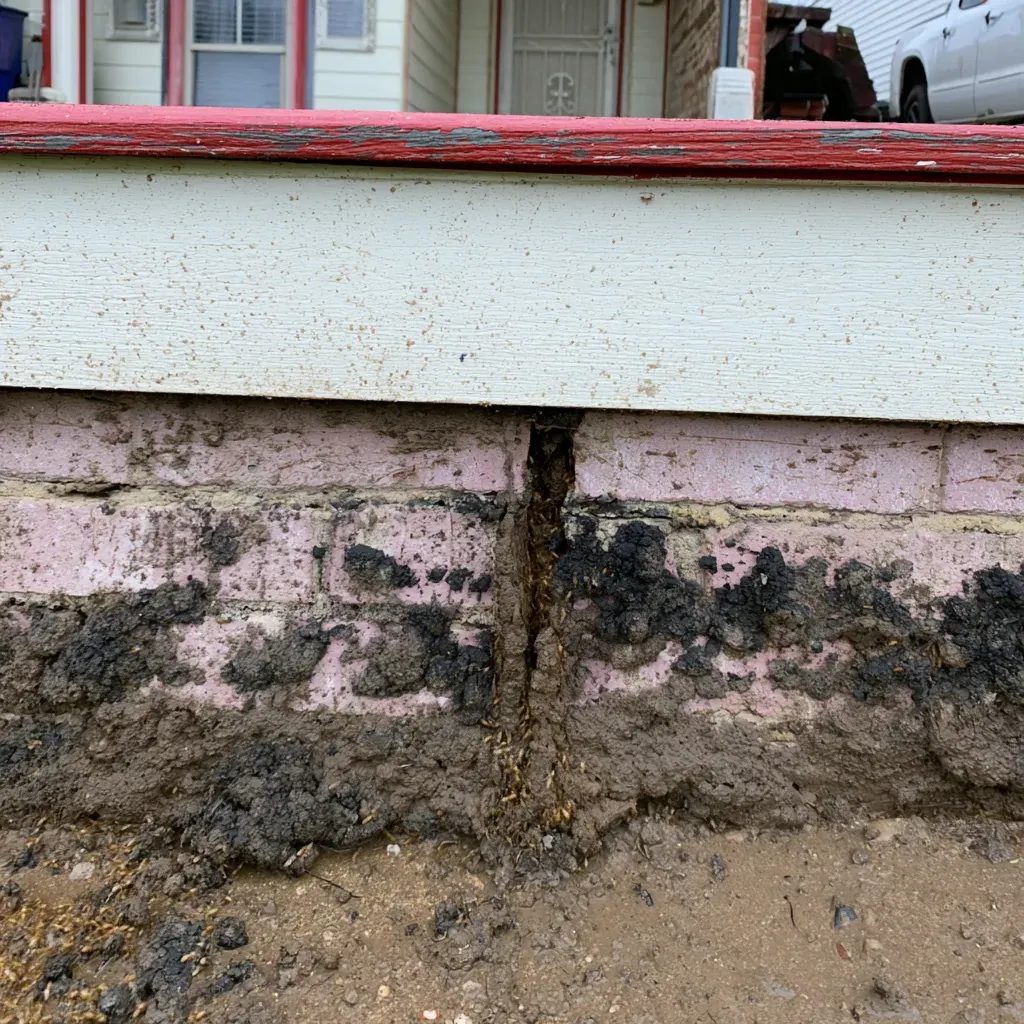
Pencil-width tubes of soil and saliva on block, brick or a pier are the highway between the colony and the wood. Termites can build them at roughly two and a half inches an hour, which is why a wall can look clean one month and marked the next.
Workers eat the soft spring wood and leave a thin shell. Press it and it dents or crumbles, and tapping it sounds hollow rather than solid.
On a slab home the flight often comes out at the joint where the floor meets the wall, or beside a plumbing penetration in a bathroom. Insects appearing there in daylight are worth a same-week inspection.
Concrete slab on grade is one of the most common construction types in North Carolina, and Cumberland County has plenty of it alongside the crawl space stock. On a slab the way in is the bath trap, the plumbing outlets, the construction joint, and the gap that opens where the slab shrinks back off the foundation wall. None of that is visible from the yard, which is why slab homes are often found late.
Sandhills soil does something specific that matters here. The surface drains fast after a storm, so the ground looks dry, and then it holds damp underneath the mulch, the bottom course of brick and the boards on the shady side. That band of quietly damp soil against the foundation is exactly the habitat a subterranean colony wants.
The swarm season is far longer than national advice suggests. Because flights run from late winter into early fall rather than in one spring week, homeowners here get several chances to see the insects and often assume a March swarm was the only risk. Annual inspection, which the state recommends, catches what a single lucky sighting does not.
Cumberland County's clay-heavy soil holds moisture against slab edges and pier-and-beam crawl spaces alike, giving subterranean colonies an easy path into homes across Fayetteville. The same ground conditions extend outward toward Eastover and Stedman, where older wells and drainage ditches keep subsoil damp through the warmer months, and southwest toward Rockfish, where sandy lowlands near Stewarts Creek stay saturated long after rain. The licensed pros we connect you with treat foundation lines differently depending on which of these conditions is feeding the colony.
Closer to downtown, Haymount's older lots near Cross Creek and the Arsenal Avenue corridor carry a different risk: mature trees and shaded, humid crawl spaces that rarely dry out even in summer. Historic foundations near the Edgar Allan Poe House often have brick piers with gaps that give a colony easy, hidden entry. South toward Hope Mills, homes closer to Hope Mills Lake face similar moisture pressure from the shoreline itself. In Fayetteville, the age of the foundation matters as much as the soil around it.
Sandy loam holds less water than clay, but Cumberland County is not uniform, and termite pressure shifts with it. South along NC 87 toward Gray's Creek and Elizabethtown, and north on US 401 past Lillington, soil composition changes enough that colonies forage differently than they do near Fayetteville proper. A slab poured on shifting sandy fill cracks sooner than one on stable clay, and that crack is exactly the gap a subterranean colony needs to reach the wood above.
The same job gets done in Hope Mills, Spring Lake and Fort Bragg, and everywhere else we cover around Fayetteville.
Winged ants. A termite swarmer has a straight body with no waist, straight antennae, and four wings all the same length. A winged ant has a pinched waist, bent antennae, and a front pair of wings clearly longer than the back pair. The difference decides whether you are looking at a structural problem or a nuisance, so keep a few of the insects in a bag rather than vacuuming them all up.
The usual approach is a continuous soil barrier. A trench is cut against the foundation, treated at the labeled rate, and the soil returned, with rodding through concrete where a patio, porch or walkway sits over the treatment line. On a slab the plumbing penetrations and the bath trap area get particular attention, because that is where the colony has an unbroken route from soil to framing.
Baits are the alternative and are the sensible choice in some situations: a well on the property, an area nobody can reach, or a homeowner who wants less material in the ground. Stations are installed around the structure and monitored. They do not create a barrier and they do not give quick control, and keeping a bait system agreement going normally costs more over time than maintaining a conventional treatment warranty.
Whatever is applied, the technician has to measure and graph or sketch the structure so the application rate and the price are calculated on real dimensions. Ask to see that sketch. A number produced without one is a guess.
Conducive conditions get fixed alongside the treatment or the problem returns. Exterior woodwork wants a minimum of 6 inches of clearance above soil, crawl space beams at least 18 inches above ground so the space stays inspectable, cellulose debris out from under the structure, and grading that sends water away from the wall.
Plenty of eastern subterranean termite situations are done in one call. What decides it is whether the pressure came from an event or from conditions that are still there.
| How it presents | What that usually needs |
|---|---|
| One place, one cause, spotted early | A single visit |
| A pattern rather than an incident | Cover through the year |
| Anything set up inside the structure itself | Both: the animal and the hole |
Two North Carolina points are worth knowing before you sign anything. First, any agreement for the control of wood-destroying organisms has to be in writing and must carry six items: the license number and phase, a foundation diagram marked active or inactive, the location of visibly damaged timbers, whether re-inspections happen and how often, the conditions for re-treatment, and the total price. Second, the re-treatment obligation runs within 30 days of written notice. NCDA&CS also says plainly that you should not be rushed, since termites do not cause significant structural damage in a matter of weeks.
Damage follows the grain in the soft spring wood, so a joist can look sound from below and be largely hollow inside. Repair work is normally sistering or replacing individual members, not wholesale reframing, and it belongs to a carpenter rather than the pest company unless the agreement specifically covers damage repair. Worth remembering: the WDIR-100 is not a damage report, so a report can note evidence without telling you what it cost the structure.
Homeowner effort pays off on the conditions rather than on the insects. Pulling mulch back off the siding, moving a firewood stack away from the wall, fixing the spigot that keeps one corner wet, clearing scrap lumber out of the crawl space, all of that genuinely lowers pressure and none of it needs a license. What does not work is a hardware store spray on a mud tube. It kills the workers you can see, the colony reroutes, and you have removed the evidence an inspector needed while the feeding continues out of sight.
Budget an estimated $425 to $1350 for eastern subterranean termite locally, and treat that as a range to plan against rather than a price. The inspection is free and the scope goes on paper before any work happens. The pricing guide carries the full bands and what shifts them, and the work itself falls under Termite Control.
Softwood framing. Often heard before it is seen. The old house borer works in softwood framing, which makes the name misleading.
Yard pest. Stings, and rebuilds fast. Fire ants like open sandy ground that warms fast, which describes most yards, ball fields and roadside strips in Cumberland County.
Breeds indoors. Needs a follow-up visit. German cockroaches are the one species that breeds indoors, in kitchens and bathrooms, and they rarely walk in from outside.
No. NCDA&CS states that a clear report is neither to be sought nor required to close, because most North Carolina homes over 10 to 15 years old show some evidence of wood-destroying insects. The WDIR-100 is a disclosure of what an inspector could see, not a pass or fail grade. Get it early in the transaction and read the conditions on the reverse.
Almost certainly not. Formosan subterranean termites were first detected in Brunswick County in 1992 in imported railroad ties and have been identified in only a few locations statewide, roughly 100 miles from Cumberland County. North Carolina has at least three native subterranean species and the eastern subterranean termite is the one you have.
Yes. Swarming begins in late winter and continues into September or October, so an August flight on a warm day after rain is ordinary here. That long window is one reason the one-spring-swarm advice on national pages misleads people in this state.
A typical single-family soil treatment is a day of work, sometimes less on a small slab, longer where a lot of concrete has to be drilled and patched. You can stay in the house.
Locally the published figures start around $75. The pros we connect you with generally sit slightly below that, so an estimated $65 to $110 depending on the size of the structure and how accessible the crawl space is. That is a guide figure and not a quote.
It comes with whatever the written agreement says, and there are three kinds in North Carolina: re-treatment only, which is the most common practice in the trade and buys you another treatment rather than a new joist, re-treatment plus damage repair up to a stated amount, which not every company offers, and no warranty, which has to be stated clearly. Read which one you are being sold before you sign.
Book an inspection at no cost. Naming it correctly is what decides whether the treatment holds, and nobody charges you for having a look.
Call (855) 563-1479