A hole you could have drilled with a bit
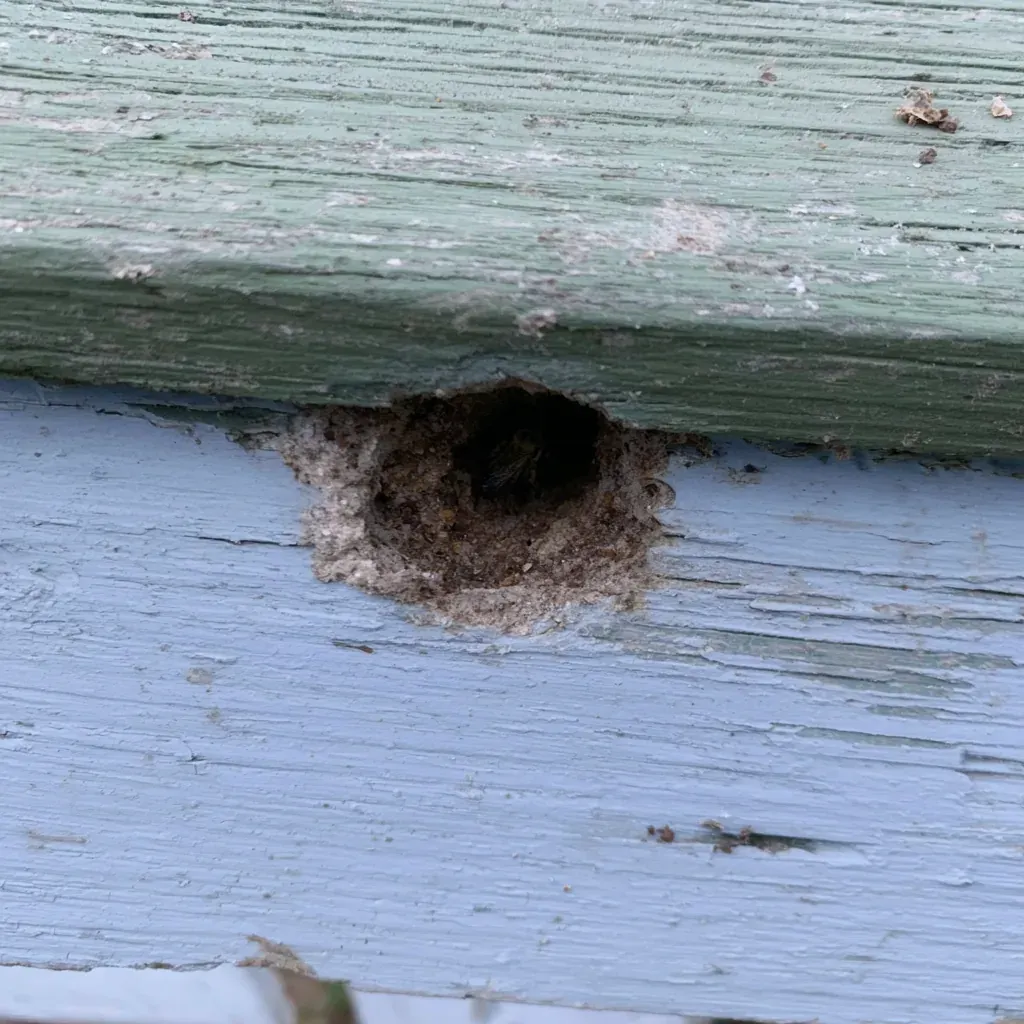
Round, about half an inch across, cut straight into the wood for an inch or so and then turning at a right angle to run with the grain. Nothing else in the yard makes a hole that neat.
Drilling starts in spring as the weather warms and continues through summer, with the next generation emerging in late summer.
A carpenter bee hole is unmistakable: a clean circle about half an inch across, drilled into bare wood, with a small cone of pale sawdust on the ground below. Unpainted fascia, deck rails, porch ceilings and shed trim take almost all of it. The second wave of damage is worse than the first, because woodpeckers hear the larvae and tear the gallery open. Paint or a sealed finish is the real prevention.
These signs usually show up before the pest itself does.
Round, about half an inch across, cut straight into the wood for an inch or so and then turning at a right angle to run with the grain. Nothing else in the yard makes a hole that neat.
Fresh pale shavings on the deck boards or the ground mark active drilling. The yellowish brown streak underneath is waste from the gallery, and on white trim it shows up from the driveway.
Males patrol in front of the nest and will fly straight at anybody who walks under it. They cannot sting. It is unnerving and it is also a reliable pointer to where the hole is.
Housing style decides this one. Front porches, screened porches, wooden decks, detached workshops and storage buildings are all common across Cumberland County and Hope Mills, and the parts of them that never get painted are exactly the parts these bees want. Rafter tails, the underside of a handrail, the back edge of fascia and the top of a deck joist are the four places to check first.
The warm season is long here, which stretches the activity window at both ends. Drilling can begin on a mild March afternoon and the emerging generation is still working the same boards in late summer, so a spring plug and paint job left until fall gives them a full season of use.
Then the woodpeckers arrive, and that is where the money goes. A gallery full of larvae is a food source they can hear, and the resulting excavation turns a half inch hole into a torn strip of fascia. A great deal of what people report as woodpecker damage in this county started as three or four bee holes.
Fayetteville's older fascia boards aren't unique either. Out along Dunn Road near Godwin, the eaves on weathered farmhouses take the same soft-pine drilling, and up toward Linden by way of US 401, homes near the old Linden School show identical rows of holes before a woodpecker ever turns them into torn strips. The pattern holds wherever the wood is old enough to sound hollow.
Riverside neighborhoods carry their own version of the same story. Near the Cape Fear River and Juniper Creek around Erwin, older siding takes on moisture that softens it just enough for a queen to start a gallery, and the Lumber River's damp bottomland near Lumberton shows the same round holes on sheds and detached garages. Fayetteville homes with similar shaded, slow-drying trim face identical odds, which is why a call to the licensed pros connected through this site catches it before the pecking starts.
Woodpecker damage on eaves and fascia turns up wherever carpenter bee tunnels have had a season or two to spread, and that pattern reaches well beyond Fayetteville. Homes near Old Bluff Presbyterian Church in Wade carry the same shaded soffits, while porch trim out toward Falcon Tabernacle and the sandy lots along the South River see the same pecking once the larvae inside are heard. Godwin Presbyterian Church's older outbuildings show it too, which is why the licensed pros we connect you with check the wood before the birds do the finding for you.
Homes in Erwin, Lumberton and Wade get treated for it on the same terms as Fayetteville itself.
Bumble bees. Look at the top of the abdomen. A carpenter bee is shiny and black there, a bumble bee is fuzzy and banded. Bumble bees nest in the ground or in an old bird box and do no damage to wood, so misidentifying one gets a beneficial pollinator killed for nothing while the actual gallery keeps being reused.
The sequence matters more than the product. Treat the gallery first with a dust or a labeled residual so the bee carries it into the tunnel, leave it a day or two, then plug the hole with a wood dowel and exterior filler, and only then paint or seal. Plugging a live gallery without treating it traps larvae that chew a fresh exit, and painting over a fresh plug that was never treated simply hides the problem for a season.
Prevention is a finish, not a spray. These bees avoid painted and properly sealed surfaces, so the lasting fix is priming and painting bare softwood trim, capping exposed rafter tails, and using hardwood or a sealed composite on rails that never seem to hold paint. Where a structure cannot practically be painted, such as an unfinished shed, expect this to be an annual visit rather than a single job.
Whether carpenter bee wants ongoing cover comes down to the cause. Fix a route in and it is a job. Leave a damp crawl space and it is a season.
| Your case | What we would advise |
|---|---|
| Something contained, in one part of the property | Treat it once |
| Pressure off the yard or the marsh, year after year | Recurring visits |
| Something living in the crawl space, a void or the attic | Treatment with exclusion work |
One season of drilling is cosmetic. The problem is reuse: the same boards are worked year after year, the galleries branch, and a rail or a fascia board eventually loses enough wood to fail, usually along with the woodpecker damage on top of it. The repair is straightforward carpentry, and the only version that lasts includes a painted or sealed finish on the replacement, because bare new pine is just as attractive as the wood that came off.
This is one of the better homeowner projects, with two cautions. The work happens at ladder height on a porch ceiling or a fascia board, and treating a gallery over your head while a male patrols in front of your face is how people fall. And timing counts: plug in fall or winter once activity has stopped, or treat before you plug. If the holes are above a second story, or there are more than a handful, it is worth handing to the licensed local pros we connect you with, who will do the height work and the paint recommendation in one visit.
Carpenter Bee normally comes in somewhere from an estimated $95 to $225, with access under the floor moving it as much as anything. The inspection is free and the scope goes on paper before any work happens. The pricing guide carries the full bands and what shifts them, and the work itself falls under Wasp Nest Removal.
Many queens. Splits when disturbed. Argentine ants build very large colonies with many queens, and neighboring nests cooperate instead of fighting.
Strong flier. Works from the roofline down. Smokybrown cockroaches breed in leaf-packed gutters, tree holes, deep mulch and attic voids, and they fly well.
Travels with people. Never a housekeeping failure. Leave the bed exactly as it is until the inspection is done.
The male doing the aggressive flying cannot sting at all. The female can, and rarely does unless she is handled or trapped against skin. The alarming part of the encounter is the harmless part.
Not on its own. Filling a gallery that still holds larvae leaves them to chew a new opening, often right beside the plug. Treat, wait, plug, then seal or paint, in that order.
They catch some bees and they are harmless to try. They will not clear an infestation on a house with a long run of bare fascia, because the wood is still the attraction. Treat them as a supplement to painting, not a substitute for it.
Treating and plugging the holes on a typical porch and deck runs an estimated $110 to $210, depending on how many galleries there are and how high they sit. Painting and any board replacement are separate, and they are what stops it coming back. Guide figures rather than a quote.
One free inspection settles what it is and how far it has traveled. The estimate lands in writing before a technician starts.
Call (855) 563-1479