Squirrel work fails in a predictable way. The animal is removed, the opening is covered with a scrap of plywood or a piece of vent screen, and six weeks later there is a fresh hole in the same corner of the fascia. Nobody was careless. The removal simply was never the difficult part of the job, and almost every quote is written as though it were.
A one way door, not a trap on the lawn
The usual method is a one way door fitted over the active entry, so the animal leaves to feed and cannot get back in. Every other opening on that roofline gets closed first, or it just moves along the soffit and you are back where you started with a door on the wrong hole. Then you wait and watch, because a squirrel shut out of its own attic is loud and persistent about trying to get back in, and that noise is useful information.
Check for young before you close anything
Gray squirrels raise young more than once a year, so there is no month where you can assume an attic is empty. Sealing a nursing female out leaves a litter in the insulation that cannot follow her, and that ends as an odor in a wall cavity and a hole cut in a ceiling to reach it. It is the worst possible version of this job and it is entirely avoidable.
The signs are worth knowing. A female returning to one spot repeatedly at the same times of day, faint chirring behind a soffit or inside a wall, and nesting material pulled into a tight bundle in one location rather than scattered across the attic. If there is any real doubt, the exclusion waits.
Wood alone gets chewed open in the same place
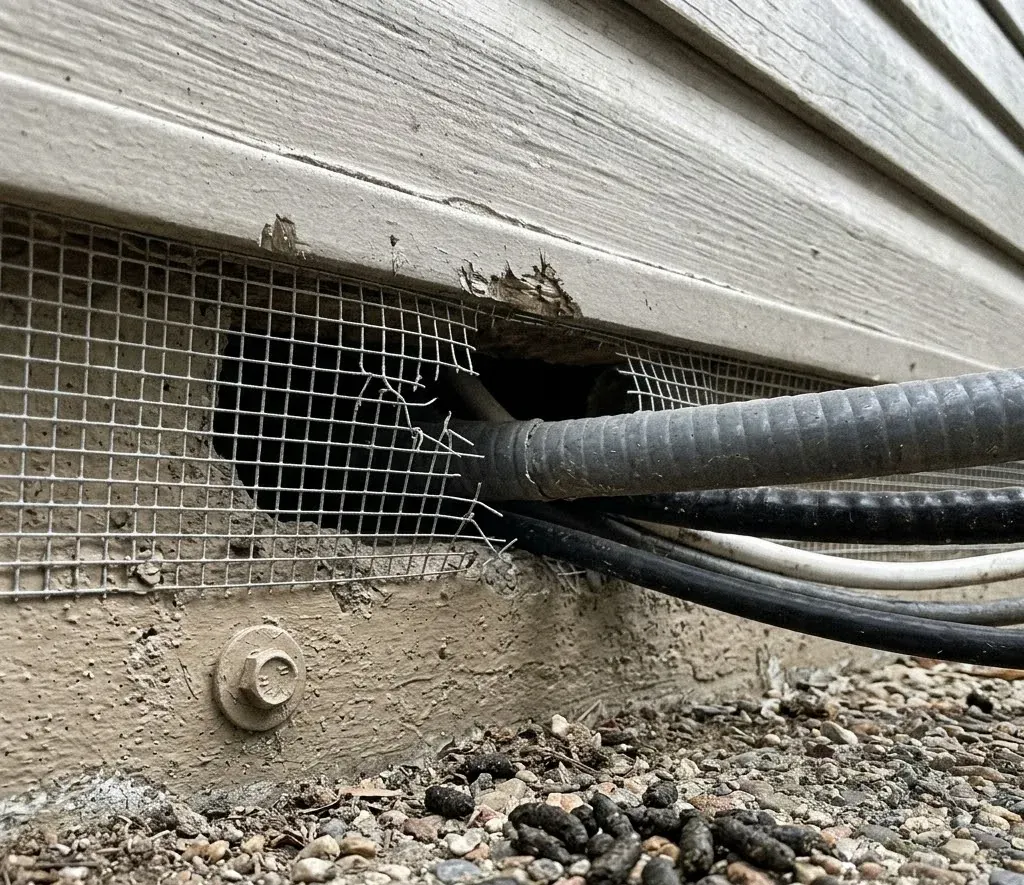
A squirrel remembers the opening, and a plywood patch is the same material that lost the first argument. A repair that holds has metal in it: hardware cloth behind the void, and sheet metal or flashing across the face, cut back past the chewed edge onto sound wood, fastened rather than glued, and painted so it disappears into the trim.
Rotten fascia or soffit board gets replaced, not covered. Screwing good metal onto soft wood gives you a strong patch on a weak substrate, and the fasteners work loose within a year. If the board crumbles at the edge when you push a screwdriver into it, it is a carpentry job before it is a wildlife job.
The risk that is not the noise
Squirrels gnaw wiring. That is the reason attic activity does not belong on a list of things to look at next spring. Insulation gets stripped off cable runs, staples get worked loose, and all of it happens where nobody ever looks. Where there has been activity in an attic, the wiring in that area is worth having looked at by somebody qualified to judge it.
The rest of the cost is quieter and adds up anyway: insulation compressed flat and soiled, chewed flex duct losing conditioned air into the attic, and stained ceiling board under the nesting spot.
Cut the bridge, not just the hole
Squirrels reach a roof along limbs, fence rails and whatever is stacked against the house. Trimming branches well back from the roof edge removes the easy route and takes most of the pressure off the repair. Aim for a real gap rather than a tidy trim, because a squirrel jumps considerably further than people assume, and a limb that only just clears the gutter in October will be touching it by June.
Keep the fascia from rotting in the first place
There is usually a reason the entry point appeared at one particular corner, and the reason is water. Pine straw collects in the gutter, the gutter holds water at the low end, the fascia behind it stays wet, and softened wood is easy for an animal to open. Clearing the gutters and getting the downspouts discharging away from the wall is moisture work and termite prevention as well as squirrel prevention, which is why it earns its place on more than one list.
What a holding repair looks like on paper
Ask for the scope in writing before anybody sets up a ladder. It should read roughly like this, and if it does not, ask why.
- Full roofline inspection with every opening photographed and located
- All secondary openings closed before the one way door goes on
- One way door left in place long enough to confirm the space is empty
- Young accounted for, with the exclusion delayed if a litter is present
- Rotten fascia and soffit board replaced rather than covered over
- Final closure in hardware cloth and metal, fastened and painted to match
- Limbs trimmed clear of the roof edge and gutters cleared
- A follow up visit to confirm nothing has been reopened
Dealing with this in your home?
We offer free inspections and honest recommendations across Fayetteville and the surrounding towns. Call (855) 563-1479 and we’ll help you sort it out.