Property Management
Multi-site accounts and owner reporting
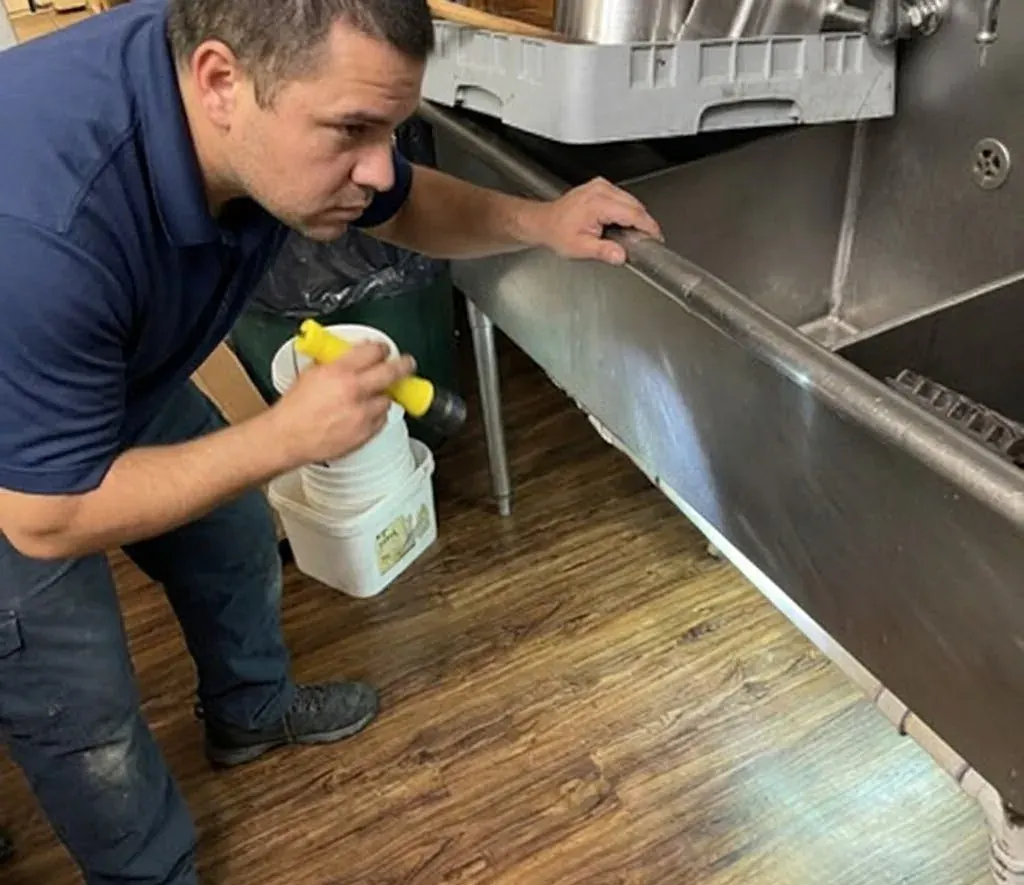
The record follows the store, so the log matters as much as the treatment.
Restaurant pest control in Fayetteville is mostly an outdoor and plumbing job. American and smokybrown cockroaches breed in mulch beds, floor drains, grease trap lids and gutters, then walk in under a propped back door after heavy rain. The licensed local pros we connect you with work the bin pad, the dock seal, the drain lines and the soil band on a set schedule, and leave a written record an inspector can read.
The two large roaches that turn up in Cumberland County kitchens breed outdoors. American and smokybrown cockroaches live in mulch, leaf litter, gutters, storm drains, grease trap surrounds and the wet seam under a bin pad. They are not looking for your kitchen. They are looking for somewhere less flooded, and after a heavy summer rain your back door is the nearest option.
Sandhills soil makes that worse in a way that is easy to miss. Surface water sheds fast, so the parking lot looks dry an hour after a storm, while the ground under the mulch, under the pad and under the slab edge stays damp for days. The habitat is still there. Anyone who treats only inside is treating the last few survivors of a population that lives six feet outside the wall.
So the program starts on the outside of the building and works inward. Soil band along the foundation, the bin pad and its wash line, grease trap lid gaskets, drain covers, downspout discharge, and the strip of mulch somebody laid up against the brick because it looked tidy.
That perimeter check matters more for a kitchen inspection than anything happening indoors, since a health inspector in Fayetteville is grading what walks in tonight, not what got sprayed last month. The same lax gasket and mulch problem shows up on routes the licensed pros we connect you with run out toward Dunn, through Erwin along the Cape Fear River, and down to Lumberton near the Lumber River, where every kitchen loses the fight from the outside first.
Floor drains are the single most productive spot in a commercial kitchen and the least often opened. Under the grate there is standing water, an organic film on the walls of the basin, and in a lot of stores a missing or cracked trap primer. Small flies breed in that film in days. Large roaches use the line as a highway between the store, the grease interceptor and the sewer.
Treatment that respects that reality is specific: pull the grates, clean to bare metal or let a drain treatment do it over several visits, then keep the seal and the primer working. A foam or a bait placed in the drain void does more than any amount of product applied to the floor around it.
Older restaurant rows in Fayetteville sit on slab plumbing that traps grease the same way kitchens do out past Wade on US 301 or further out near Falcon Tabernacle, where well water runs harder and leaves scale on top of the film. That buildup slows a drain treatment's reach and makes the primer step matter more, not less. Kitchens stretched out toward Godwin see it too, since older piping and long service runs both give grease more surface to cling to before an inspector ever lifts a grate.
Every kitchen props the back door during dish and trash runs. That is not going to change, so the fix is the threshold rather than the habit. A worn sweep, a missing corner of weatherstripping and a light gap under a dock seal will let more in over one warm week than a month of good sanitation keeps out.
Sealing is also the part of the job that outlasts the visit. A gap closed in April is still closed in August. Product applied over that same gap is gone in a few weeks.
Kitchen inspections follow the same back-door logic whether the address sits inside Fayetteville or out past it on routes the pros also cover — Interstate 95 at Exit 65 toward Godwin, NC 82 heading for Erwin, or the stretch south to Parkton in northern Robeson County. A threshold gap behaves identically in a coastal-plain kitchen anywhere along those roads: it lets in the same roaches, the same ants, the same moisture, no matter which town's water bill shows up in the mailbox.
A restaurant service is not one pass through the building. It is a rotation, weighted to the places that produce, with the whole structure covered over the course of a quarter. Anything on a shorter interval is there because it generates fast.
| Zone | What gets worked | Interval |
|---|---|---|
| Floor drains and grease trap | Grates, basin film, lid gaskets, trap primer | Every visit |
| Bin pad and dumpster surround | Wash line, soil band, lid gaps, standing water | Every visit |
| Cook line and equipment voids | Behind and under equipment, hinge points, legs | Every visit |
| Back door and dock | Sweeps, seal, threshold light gaps | Monthly |
| Dry storage | Cartons, pallet bases, shelf corners, spill trails | Monthly |
| Foundation and mulch line | Mulch depth, spigots, downspout discharge | Quarterly |
Most kitchens here land around an estimated $95 to $210 a visit. Square footage moves it, the number of floor drains moves it, and a shared bin pad behind a strip of four tenants moves it more than either, because you are effectively paying for a problem three other operators contribute to. A first visit runs higher than the ones after it, since it carries the full inspection and the initial knockdown.
Monthly is the common interval for a full service kitchen. Bars, coffee shops and small takeout counters often hold fine on a longer cycle once the exterior is right. Ask for the interval to be justified by what is being found, not set by whatever the contract template said.
Sites like this get covered across Cumberland County, including Hope Mills, Spring Lake and Fort Bragg. Run several locations and they are set up as one account rather than quoted one at a time.
Budget an estimated $85 to $239 per visit as an opening figure here. How often somebody comes, and what has to be evidenced afterwards, both change that more than square footage does. There is no charge for the first walk round, and nothing is agreed until the scope is written. Every range is set out on the pricing guide, and the commercial overview covers how a scheduled account actually runs.
Multi-site accounts and owner reporting
Docks, racking and inbound freight
Office suites and professional buildings
No. A routine visit is worked around service, usually in the gap between lunch and dinner or before open. Placements go in voids, drains and equipment bases rather than on food contact surfaces, so the line comes back up as soon as the technician is finished in that area. A heavy German cockroach cleanout is the exception and is normally scheduled after close.
Because they live outdoors. American and smokybrown cockroaches breed in mulch, drains, gutters and around grease traps. A hard rain floods those spaces and pushes them to higher, drier ground, which is your kitchen floor. A run of sightings after a storm points at the perimeter and the drains, not at your cleaning.
It makes the exterior work more important, not pointless. The pad, the soil band around it and the doors on your side of the wall are still yours to control, and they are what decides whether a population living on that pad gets inside your store or your neighbor's. It is worth raising the pad with the landlord in writing.
Monthly suits most full service kitchens in Fayetteville. Interval should follow what monitors and sightings show, so a store with a clean run of records can often move to every other month on the interior while keeping the exterior and drains on the shorter cycle.
A dated log of every visit, what was applied and where, what was found, and what corrective action was recommended, plus your own note of sightings between visits. That file is the thing that shows a pattern of control rather than a single tidy afternoon, and it is far easier to hand over than to reconstruct.
Call and we will connect you with licensed local pros who will start at the bin pad and the drains, then tell you plainly which gaps are yours and which belong to the landlord.
Call (855) 563-1479