The local conditions behind it
This is a market with a lot of ground level access. Crawl space homes here have vent openings, access hatches and skirting that all age, and one rotted screen at the back of the house is a door. Add the sheer number of raised decks, detached sheds and screened porches on a slab, and there is usually somewhere dark and dry within twenty feet of a back step.
Sandhills ground does something helpful for a denning animal. The surface drains fast, so the space under a deck or shed is not a puddle after a summer storm, and the soil underneath stays cool and damp rather than baking. That is close to ideal for an animal that wants shelter for a few weeks without doing any construction to get it.
Then there is the food, which is where most of these situations begin. Opossums eat almost anything, so a porch cat bowl, an unlatched trash cart, a compost pile or fruit dropping off a tree keeps one coming back nightly. They also eat a lot of ticks, snails and carrion, which is a genuine argument for tolerating one that is passing through the yard rather than living under your floor.
Crawl spaces are common under Fayetteville's older ranch homes, and a deck skirted with lattice or missing a board makes an equally easy entrance. Around Hope Mills, low ground near Little Rockfish Creek and Rockfish Creek keeps soil damp enough that a den under a shed stays comfortable through summer, and in Haymount, sheds tucked behind older houses near Arsenal Avenue offer the same shelter. Once denned, an opossum rarely leaves on its own.
The pros we connect you with also field these calls outside city limits, since a crawl space is a crawl space wherever the county line falls. Out toward Wade, older homes near Old Bluff Presbyterian Church sit close enough to low ground that opossums move in without much notice, and the same goes for Godwin, where lots along Dunn Road back up to brush an opossum can use for cover. A homeowner in Fayetteville dealing with scratching under a shed floor is looking at the same animal, the same habits, and the same fix.
Farther out, Parkton sits about ten miles south in northern Robeson County, and the drainage ditches along its low-lying lots give opossums the same easy denning cover found under a Fayetteville shed. St. Pauls, off I-95 at Exit 33, has older homes near Broad Street with pier-and-beam foundations that invite the same crawl space activity. Up toward Linden, homes near the old Linden School back onto woods along the Little River, another setup opossums favor. Wherever the pattern shows up, the licensed pros we connect you with handle it the same way.
We deal with this across Fayetteville and the surrounding towns, Hope Mills, Spring Lake and Fort Bragg included.
Know what you are looking at
- Size
- About the size of a house cat, with a long hairless tail
- Color
- Grizzled gray body, white face, dark ears and legs
- Active
- Night, and it will freeze rather than run when caught in a light
- Den style
- Uses an existing gap under a structure, and does not stay long in one place
- Young
- Carried in a pouch, then on the mother's back once they outgrow it
- Season
- Active all year in this climate, with denning most obvious in cold snaps and when females are carrying young in spring and again in summer.
- Typical treatment
- an estimated $175–$525
What it gets mistaken for
A very large rat. In a flashlight beam at the edge of a deck, the tail is what people see, and a bare tail on something moving low to the ground reads as a rat. An adult opossum is far bigger, has a white face and a pointed pink nose, and freezes in the light instead of bolting for cover. Size settles it in a second once you have seen both.
What happens when someone comes out
Because they move on readily, the work here leans on timing rather than force. Confirm which gap is being used and whether young are present, then fit a one-way device or wait for the animal to leave at dusk, and close the opening properly once you know the space is empty. Sprinkling a little flour at the entrance and looking at the tracks in the morning is a reliable, free way to know whether anything is still using it.
The permanent part is the barrier. Deck skirting and shed perimeters get hardware cloth buried and turned outward in an L so nothing can push under the edge, and crawl space vents and access doors get metal screening and hardware that actually latches. Then the cleanup and deodorizing under the structure, because leaving the waste in place leaves the invitation. Where the den was in a crawl space, this is also the moment to check the insulation above it and the ductwork, since a torn duct in a fouled space pulls that air into the house.
The split with opossum is simple enough: something contained gets treated once, while pressure arriving from outside every season is what cover is for. There is no winter here that resets it.
Is this a job or a schedule?
| How it presents |
What that usually needs |
|---|
| Something contained, in one part of the property | Treat it once |
| Pressure off the yard or the marsh, year after year | Recurring visits |
| Something living in the crawl space, a void or the attic | Treatment with exclusion work |
The damage and the clean-up
Compared with a raccoon this is mostly a mess rather than a wrecking job, and that distinction saves people money once they know it. Expect fouled ground, contaminated crawl space insulation, disturbed vapor barrier, chewed or displaced duct insulation, and a smell that outlives the animal. What you will not get from an opossum is a torn soffit, a lifted ridge vent or a hole punched through a roof deck. If that damage exists on the same house, something stronger made it and sealing up after the opossum leaves the real entry point wide open.
What is genuinely worth doing yourself
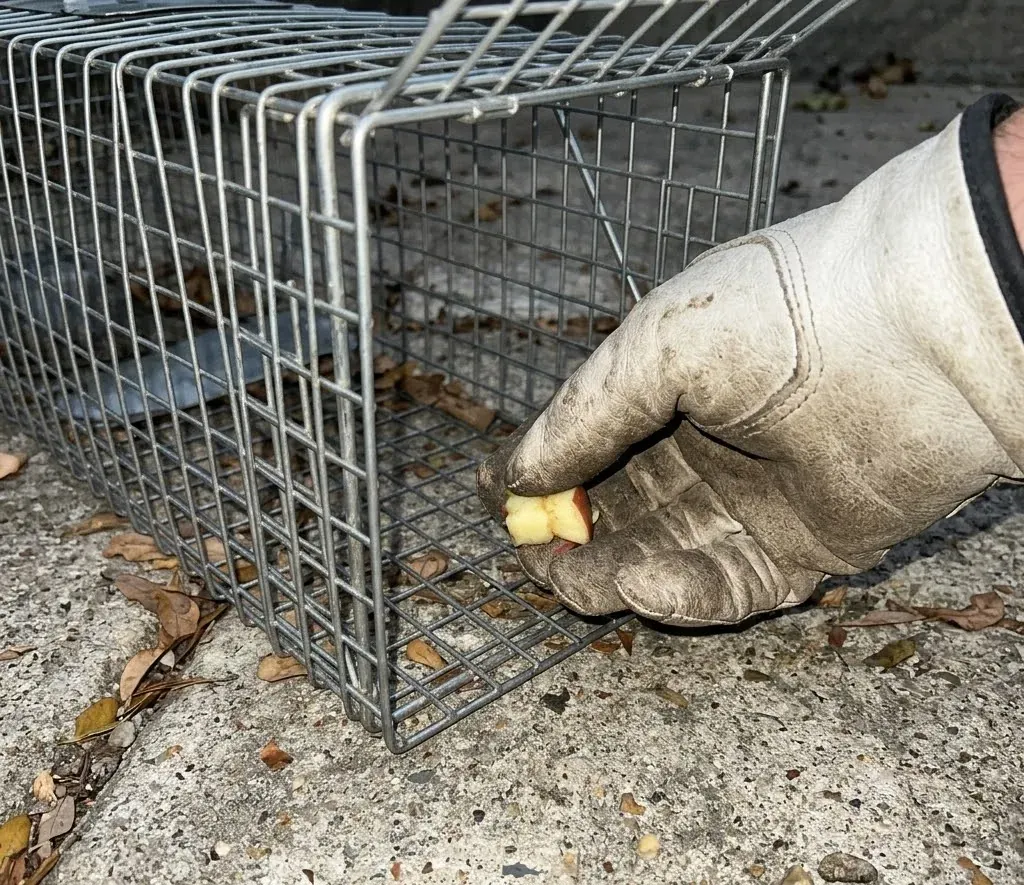
Removing the reason it came is real work and you can do all of it. Feed pets indoors, latch the trash, pick the fruit up, clear the brush pile, and close the gap in the deck skirt with hardware cloth rather than lattice. Leaving a single one-way exit and checking for tracks is also within reach for most people. Where it goes sideways is grabbing at the animal or trapping it. It will hiss and show its teeth, which frightens people into doing something abrupt, and a stressed animal in a cage in the wrong hands is how somebody or a dog gets bitten.
Before you ring round
Work on opossum generally falls in an estimated $175 to $525 band. How long it has been going on decides most of the rest. Having somebody look costs nothing, and you see the number in writing first. See the pricing guide for the complete set of ranges, and this one is handled under Wildlife Removal.