Why this one turns up here
Water and cover are the two things that decide where raccoons are dense, and Cumberland County has plenty of both. The Cape Fear River corridor, Cross Creek through the middle of the city, and the creek lines running toward Hope Mills all give continuous travel routes with tree cover, and a suburban street backing onto any of that has a resident population whether anybody has seen one or not.
The rest is food, and it is all supplied by people. Trash carts left out overnight, pet bowls on a porch, birdseed under a feeder, and fruit off a tree nobody picks. An animal that eats well behind your house is an animal that eventually looks at the roof of your house, especially in late winter when a female needs somewhere dry to raise young.
Fayetteville's older neighborhoods with mature pines and gutter-shaded rooflines give raccoons an easy climb to a soffit gap or chimney cap. The same pattern shows up well outside city limits, where the licensed pros we connect you with also work: toward Clinton on NC 24, farmhouses near the Clinton Depot have brick chimneys raccoons treat as a ready-made den, and around Roseboro, older homes near the Howell-Butler House see the same late-winter denning behavior in cold flue stacks and loose attic vents.
Chimney flashing and cap condition tell the same story along US 301 northeast of town, where the licensed pros we connect you with also work: near Godwin, older farmhouses along Dunn Road and close to Interstate 95 at Exit 65 often have uncapped stacks that raccoons widen into denning sites, and out toward Linden by way of US 401, detached garages with gapped soffits see the same late-winter entry Fayetteville homeowners report closer to town.
Roofline age matters as much as road distance, which is why the same raccoon pattern turns up well past Fayetteville. In Lumberton, older neighborhoods near Luther Britt Park still carry box vents and ridge caps installed decades ago, easy points of entry once a seam works loose. North toward Erwin, homes close to Juniper Creek see the same chimney denning in late winter, and the licensed pros we connect you with treat both as one job, not two.
Homes in Hope Mills, Spring Lake and Fort Bragg get treated for it on the same terms as Fayetteville itself.
The short facts
- Size
- Commonly 10 to 25 pounds, larger going into winter
- Hands
- Dexterous front paws that pull, grip, turn and lift
- Active
- Mainly at night, though a nursing female will move in daylight
- When
- Denning peaks late winter into spring when litters are born, with a second wave of activity as young disperse in fall.
- Guide price
- an estimated $175–$525
The look-alike worth ruling out
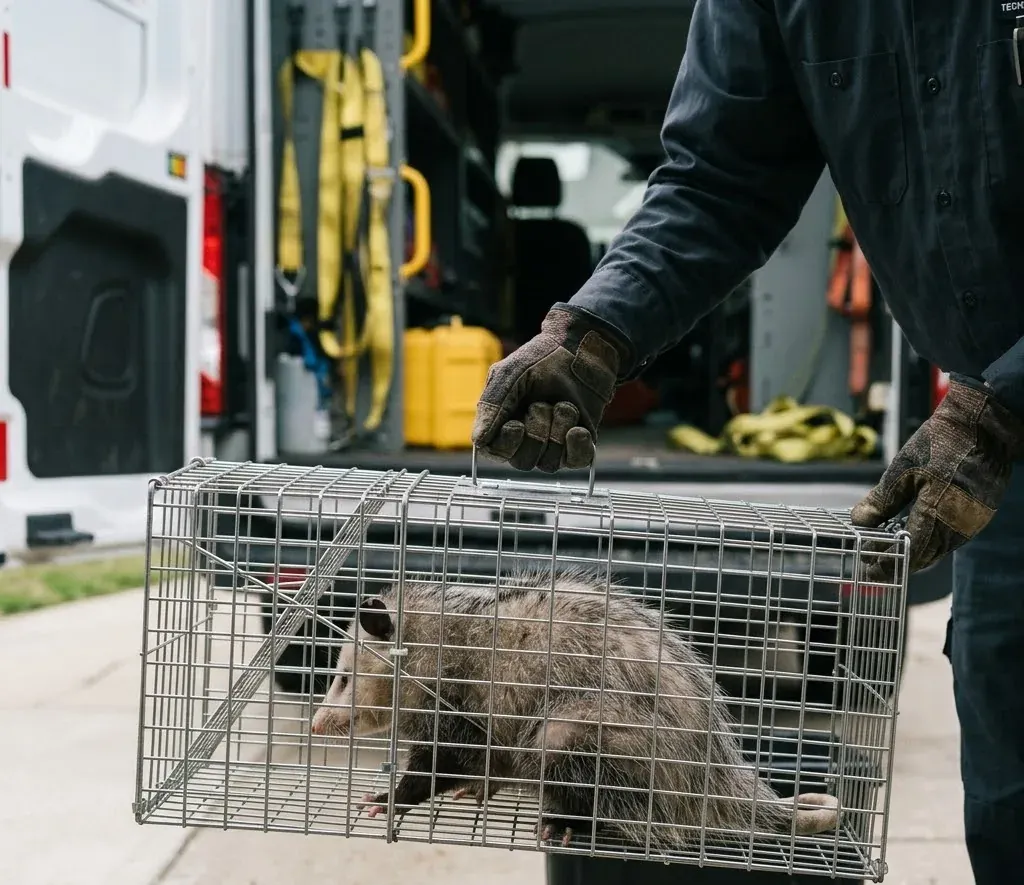
Opossums, which get blamed for raccoon damage. An opossum can climb but it cannot force a building open, so torn soffit, lifted vents and stripped shingles are raccoon work. If you have seen an opossum in the yard and also found that kind of structural damage, you probably have both, and only one of them made the hole. Chasing the wrong animal means the entry point never gets found.
What treatment actually involves
The first question is whether there is a litter, and it decides everything after it. Sealing an opening on a female with young in a wall or an attic gets you a frantic animal tearing at drywall from the inside to reach them, or dead young in a void. So the inspection includes finding the nest, and where there are kits the work is either a hands-on removal of the young with the mother excluded afterward, or a short wait until they are mobile enough to leave with her.
Once the space is confirmed clear of young, exclusion is the same principle as any other animal and heavier in every dimension. A one-way door built for the weight, then repairs in materials that match the animal: steel mesh, screws rather than nails, sheet metal over a rebuilt soffit, a proper chimney cap with a spark arrestor rather than a screen laid over the flue. Raccoon exclusion that holds is closer to metal fabrication than to caulking.
Then the cleanup, and with a latrine present that is not just tidying. Contaminated insulation comes out, surfaces are cleaned and treated, and the affected area is deodorized because scent draws the next animal to the same spot. Ask what the plan is for the latrine specifically. A company that quotes removal and sealing with no mention of it has left half the work out.
Nobody needs a schedule for a raccoon problem with an obvious start and an obvious end. Anyone who says otherwise is working from a sales sheet.
Which of the two your situation calls for
| What you are looking at |
The fit |
|---|
| One place, one cause, spotted early | A single visit |
| A pattern rather than an incident | Cover through the year |
| Anything set up inside the structure itself | Both: the animal and the hole |
Timing is not optionalThe person doing this work in North Carolina is a Wildlife Control Agent, the state term for the licensed operator, and the North Carolina Wildlife Resources Commission publishes a list of them. That matters because the handling, transport and release of a wild animal is regulated, and homeowner trapping frequently runs into rules people did not know existed. The pros we connect you with work to those requirements.
The mess is the second job
The scale of it surprises people who have only dealt with rodents before. Soffit and fascia pulled apart, ridge vents lifted, shingles stripped at a valley, ductwork crushed or torn open, ceiling drywall stained through from a latrine above, and insulation both compacted and fouled across a wide area. In a chimney, nesting material sitting on a smoke shelf is a fire hazard until it is physically removed. Repairs commonly involve a roofer as well as the wildlife work, and the insulation is usually a partial replacement rather than a patch.
What is genuinely worth doing yourself
Everything outside the building is fair game and it works. Latch or weight the trash cart, stop feeding pets outdoors, take the bird feeder down for a season, cap the chimney, and put a light where the animal walks. What is not a homeowner job is the animal itself. A cornered raccoon defends itself and will injure a dog badly, box store traps regularly catch the wrong animal or catch the mother and leave the litter, and relocation is not the simple kindness people assume. If you have found young, stop and call somebody.
Is it a health risk?
Raccoon droppings and the latrine area are the reason cleanup gets done properly rather than casually. Raccoon roundworm eggs and leptospira bacteria are both associated with raccoon waste, and raccoons are among the wildlife species that can carry rabies, which is why an animal in a living space is a call to a professional and never something to shoo out with a broom. The practical rules are simple: do not disturb dry droppings, keep children and pets out of the area, and let somebody with proper protective equipment and a disinfection plan handle the attic.
Roughly what it runs
A raccoon job around here tends to sit between an estimated $175 and $525. Which end depends on the house rather than on the insect. Having somebody look costs nothing, and you see the number in writing first. See the pricing guide for the complete set of ranges, and this one is handled under Wildlife Removal.