Why you have them and the house next door might not
Gliding changes the geometry of the problem. A gray squirrel needs a limb close enough to jump from, so trimming works. A flying squirrel launches from higher in a pine or an oak and covers real distance on the way down, which means a tree that looks a comfortable distance from the house is still a launch point. In neighborhoods here with a tall mixed canopy, there is often no tree you could remove that would solve it.
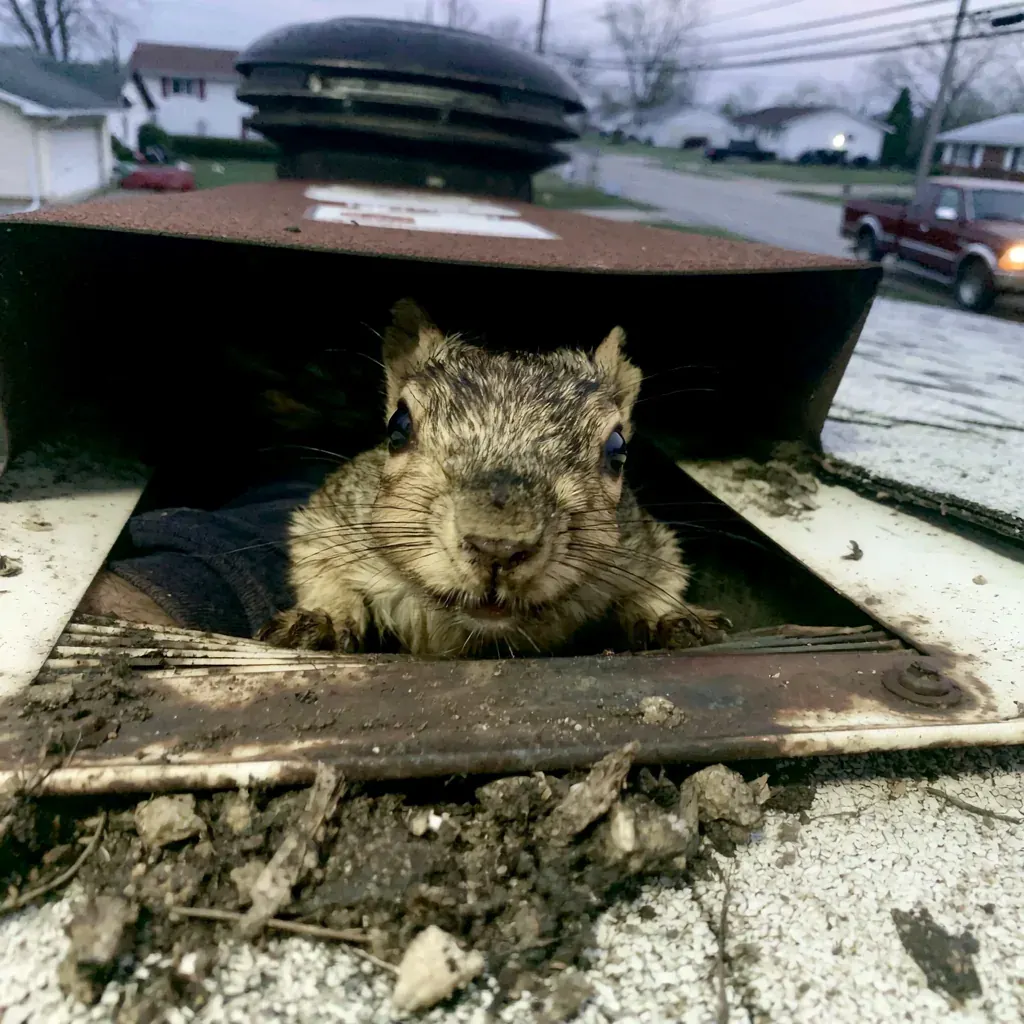
The openings they use are small enough to be missed on a normal roof check. A gap at the end of a ridge vent, a corner where a soffit panel meets brick veneer, an unscreened attic vent, the gap around a cable entry. Nothing has to be chewed. Because the animal is small and lives as a group, a single overlooked gap the size of a quarter can keep the whole colony coming back after a treatment somebody paid for.
Fayetteville's tree canopy gives flying squirrels plenty of launch points onto older rooflines, and the animal's gliding habit means it can bypass a ground-level inspection entirely. In Haymount, the mature hardwoods near Arsenal Avenue and the Edgar Allan Poe House sit close enough to gable vents for an easy glide onto the roof. Near Hope Mills Lake and along Little Rockfish Creek, waterside tree lines create the same approach into attics that owners rarely think to check from below.
Farther out, the pattern holds along wooded corridors rather than single yards: near Lillington the tree line along Poorhouse Creek gives gliders the same elevated approach into attics that Fayetteville homeowners see closer in, and around Gray's Creek, the pine-and-hardwood edge near Gray's Creek Elementary School offers the same uninterrupted canopy route down onto a roofline. The licensed pros we connect you with check gable vents and soffits first, wherever the trees sit that close.
Flying squirrels favor the same mature hardwood canopy whether the roofline sits in Fayetteville or thirty-some miles out along I-95 toward Lumberton, where oaks lean close to older rooflines near the Lumber River State Park and Luther Britt Park. Homes near Wade and the Old Bluff Presbyterian Church see the same pattern come dusk, gliders working tree limbs down onto a ridge line. The licensed pros we connect you with trap and seal rather than guess, since one open gap invites the whole colony back.
Homes in Hope Mills, Spring Lake and Fort Bragg get treated for it on the same terms as Fayetteville itself.
The short facts
- Size
- Body about 5 inches, with a flat tail roughly the same length
- Color
- Soft gray brown above, cream below, loose skin folded along each flank
- Eyes
- Very large and dark, the standard build of a night animal
- Group
- Often several sharing one nest, and more of them in cold weather
- When
- Present year round, most noticeable from fall through winter when several animals share one nest for warmth.
- Guide price
- an estimated $215–$720
The look-alike worth ruling out
Rats in the attic. Both are small, both are heard at night, and both run along the tops of walls. The evidence differs. Rats leave greasy rub marks where they travel the same route, gnaw at hard edges, and drop tapered pellets in concentrated spots. Flying squirrels leave no rub marks, scatter their droppings along runways, and cache food such as acorns and seed in a corner of the attic. Worth getting right, because rodent bait is a common answer for rats and the wrong answer here.
What a professional job looks like
Identify the species and count the exits before touching anything. Sitting outside at dusk with the roofline in view is the cheapest and most accurate step in the whole job, because you watch them leave and you learn how many there are and where they go out. That count is what tells you when the attic is actually empty later.
Then the sequence reverses the usual instinct. Everything gets sealed first except the confirmed exits, which is the opposite of what most people expect. Only after the rest of the building is closed do one-way devices go on those exits, so the animals leave into the night and cannot return to a nest they can still smell.
The devices stay on long enough to clear the whole group, and the attic is inspected before final sealing. This is where the group size matters. Assuming you had one animal, closing up after the first quiet night, and then discovering two more inside is the common way this job goes wrong.
Cleanup is not optional with a colony. Soiled insulation gets removed rather than covered, the deck and framing are cleaned and treated with an appropriate sanitizing product, cached food is taken out, and fresh insulation goes back to the depth the attic is supposed to have. Skipping the cleanup leaves the scent that tells the next colony this was a good spot.
Nobody needs a schedule for a flying squirrel problem with an obvious start and an obvious end. Anyone who says otherwise is working from a sales sheet.
One visit, or cover through the season?
| Your case |
What we would advise |
|---|
| Something contained, in one part of the property | Treat it once |
| Pressure off the yard or the marsh, year after year | Recurring visits |
| Something living in the crawl space, a void or the attic | Treatment with exclusion work |
The mess is the second job
The insulation takes the worst of it. Runways compress it, urine soaks it, and nesting pulls it apart, so the attic quietly stops performing and the summer power bill reflects it. Add gnawed low-voltage wiring, chewed cardboard and fabric in anything stored up there, and food caches that draw insects of their own. Because a colony occupies one space for a long stretch rather than passing through, the volume of contamination is usually larger than the size of the animal suggests.
What you can do yourself
Watching at dusk and counting the animals is genuinely valuable and costs nothing. Screening the vents with metal mesh and closing the gap where a cable enters the wall are reasonable homeowner jobs on an accessible single story. Where it goes wrong is trapping and relocating, since removing two animals from a group of six changes nothing and the openings are still open, and going into a contaminated attic without proper respiratory protection to pull insulation. That part is not a weekend project.
Roughly what it runs
A flying squirrel job around here tends to sit between an estimated $215 and $720. Which end depends on the house rather than on the insect. Having somebody look costs nothing, and you see the number in writing first. See the pricing guide for the complete set of ranges, and this one is handled under Wildlife Removal.